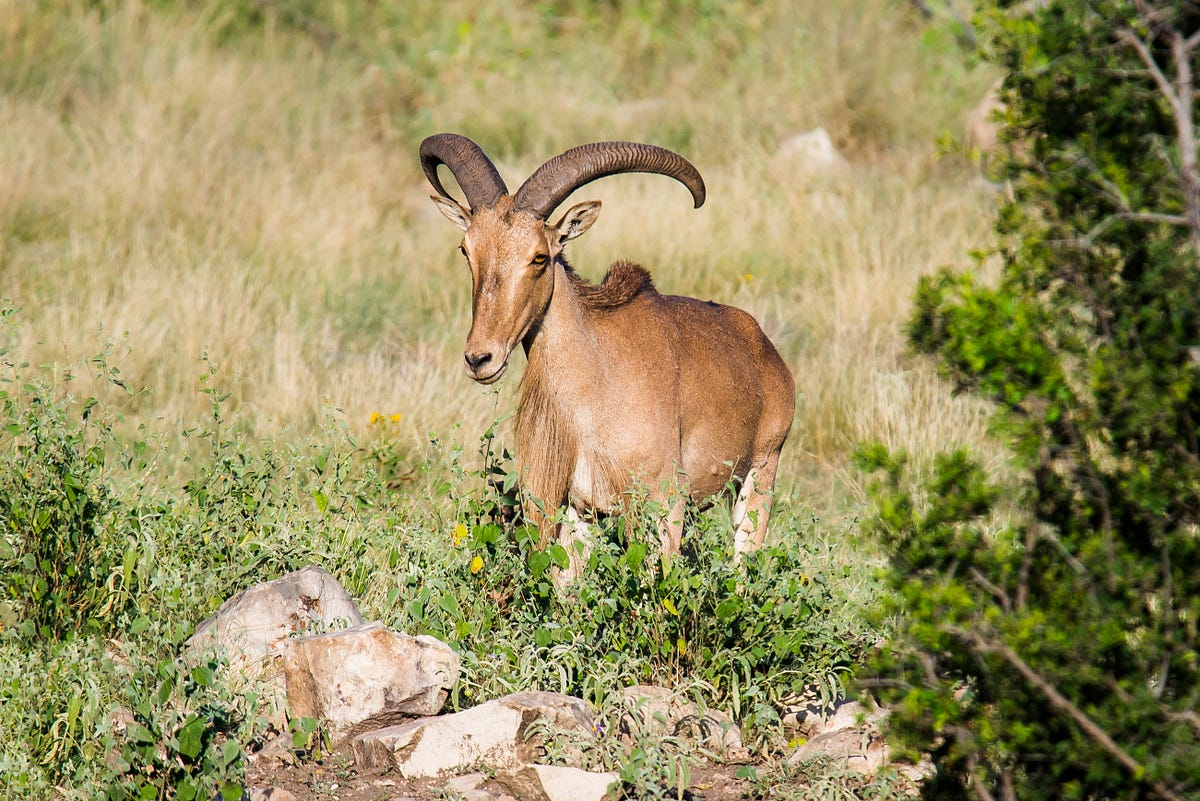
Jackie Murphy peered around a juniper, pointed upward at a 45-degree angle, then signed the sweep of aoudad horns. I did my best to spot the sheep through the ocotillo I was hiding behind. He turned, held up both hands, fingers extended indicating there were 10 rams, then went back to intently glassing them.
For the past hour we had cautiously stalked the herd of rams up a rugged, rocky limestone slope. Our initial look at the herd had occurred from far below. “May be mostly young rams, three to five years old. But the breeding season is now well past, and the rams have formed bachelor herds. I need to get a better look just in case there’s an old ram with 30-inch or longer horns,” said Jackie.
After 20 minutes Jackie had evaluated all the rams in the herd and motioned for us to retreat downslope. We used the same brush and boulders to retreat as we did to ascend. When we were out of the rams’ sight and hearing he said, “Good rams in the 26- to 28-inch horn length category, but no monsters. I knew they did not have the darker brown color of generally older rams. But a month ago while scouting, I saw a huge bodied and horned ram that was the same lighter brown color as those we just left. I wanted to be certain he was not in the group.” With that, we again started glassing slopes and ridges of the spacious 200,000-acre Catto-Gage Ranch just east of Alpine in Texas’ Trans Pecos.
Moments later we spotted more rams; a single ram here, two to three rams there. Through spotting scopes Jackie and I determined all were nice, but too young to pursue.

That first afternoon we glassed 29 rams in terrain that reminded me of desert bighorn habitat, and in many ways it was like hunting desert bighorns. But I was after aoudad sheep, which are actually more like part sheep and part goat.
Aoudad, also known as Barbary sheep, originated in the arid desert mountains of northern Africa. They were liberated in western Texas during the 1950s. Obviously the region’s rugged mountains reminded the unique species of their homeland, because they have taken to the area and claimed it as their own.
Aoudad are big animals; rams can exceed 300 pounds, ewes are smaller, but both sexes have lateral backswept horns, and both have a long mane from jaw to brisket and “chaps” on their front legs. Rams have longer horns, as well as usually longer flowing mane and chaps. Their tannish to brown color allows them to blend in with their background. Essentially they are herd animals, with herd sizes ranging from four or five to well over 100. Other than during the fall breeding season, rams tend to form bachelor herds. During the course of our hunt the largest bachelor herd we saw included over 40 rams. Alas, we spent well over half a day following the large bachelor herd high into the mountains trying to get a good look at all of them, seeking a ram over ten years old. But sadly we could not find a truly old ram. Aoudad can be aged by annual growth rings like other sheep and goats. The big herd of rams proved to be mostly “younger” rams with horns in the 26 to 28 or so inch range. We were looking for something exceeding 30 inches.
Frankly, I was looking for a special ram. In years past, I often hunted aoudad and had taken rams with horns up to 31 inches. I also wanted to take advantage of an auction item, a shoulder mount, I bought at a DSC Chapter event sponsored by Double Nickle Taxidermy in New Braunfels, Texas. I really wanted an old, long-horned, long-haired ram, but I was also prepared to go home empty-handed. However, I had great faith that Wildlife Systems’ ace aoudad guide, aoudad guru and aoudad enthusiasts Jackie Murphy could help me find just the ram I was looking for.
“11 rams! Three look like they will well exceed 30-inches,” said Jackie peering through his spotting scope. “Right at the skyline, to the left of the deep cleft about a third of the way from the end of the ridge.” I swung my binos in the direction described, located them, then immediately switched to my spotting scope.
No doubt the rams were all of a goodly size. All too were a darker shade of brown than the rams we had seen earlier. I spotted the longest horned ram in the herd. “One on the far left just to the right of the arrowhead shaped boulder looks really good. I think he might well reach 32-inches.” Said I, based on past experience and comparing it to a 31-inch ram I had shot many years earlier, a few miles east of where we now hunted.
“Yes sir, I think he will do so! Problem is, it’s far too late to go after them. It would take about an hour to get to where they are now and by then it would be dark. Let’s just watch, put them to bed and then come back first thing in the morning.” I knew Jackie was right and I liked his plan.

That night I dreamed of long-horned aoudads jumping from ridge top to ridge top. I was up and dressed long before the 5:00am alarm sounded.
We were back where we had glassed the rams the evening before in time to see black turn to gray to seeing the ridge materialize. We spotted a couple of rams, but not the bachelor herd which had disappeared over the ridge just before dark the previous evening.
“Be sure to take four or five bottles of water in your pack. I’ll take some food. I suspect like yesterday we’ll stay on the mountain all the day,” reminded Jackie as we prepared for the assault to the top.
The walk-up the mountain slope was an arduous one, fraught with thorns, spines, catclaw and small rocks on top of big rocks, which tended to slide out from under foot when stepped on. Once again, I came to appreciate my Kenetrek boots.
Once on top we moved slowly to a point where we could watch for feeding sheep. We needed to see them before they saw us.
An hour into the sit we spotted a ram’s horn on the horizon. A half hour later we saw another. One’s horns appeared to be massive, the other’s were also long, but they disappeared over the ridge. As the day wore on we decided to move to the crest where the aoudad had disappeared.
We did see the two rams again when they stood up out of their bed and stared at us less than 20 yards away. Both were definite “shooters”. Frankly I could have shot the one I thought had 32-inch horns. He was an old ram. The top surface of his horns shined from years of rubbing on brush and rocks. He gave me more than ample opportunity. The “catcher in the deal” was I was also on the hunt to film an episode for our “DSC’s Trailing the Hunter’s Moon” television show which airs year around on Pursuit Channel. But the cameraman was not in a position to record the shot, so I waited. Jackie urged me to shoot, I dearly wanted to, but did not. The two rams, which quite possibly had never before seen a human at least that close, finally had seen enough and rapidly departed.
Before the day’s end we spotted another 20 or more rams, but not what we were looking for, or too distant to stalk before running out of shooting light. Again that night I dreamed of long-horned, mane and chaps dragging the rocks aoudad rams.
At first light we spotted several rams on a distant ridge and decided to drive closer hoping to cut at least a mile off of what would be a long stalk. Heading in the direction of the rams that bore further investigation, we spotted a herd of at least 40 rams in relatively flat valley between two mountains. We slowed the vehicle only enough to make certain we were seeing what we thought we were seeing, then headed to a low ridge behind which we could park our pickup and start a stalk.
Once parked we crawled a low crest to glass the rams. They had started up the mountain to north. “Some sheep are already in the cedars on the lower slope. Some are still in the ravine. Let’s back up, work our way behind the ridge leading to the mountain. It’ll be a very long walk, crawl and climb, but, I think we might get on to them and relatively close at that,” said Jackie as we started making our ascent up the incredibly rugged, steep slope.
Several times we had to skirt around short bluffs, hang on to limbs to keep from falling off the mountain, while at the same time trying to avoid sharp spines, typical of most vegetation found in the Chihuahua desert. A couple of times too, we had to wait for mule deer to move out of our path before we could continue the stalk.
An hour later we crawled into position behind a tree and boulder where we could get a better look at the rams about 100 yards away. All we could see were in the 26 to 28 and maybe 29-inch horn length range. Thankfully, they had no idea we were anywhere close.
After seeing what we thought were all 40, failing to see any monster rams, I ejected the 180 grain Hornady InterBond round from of my Ruger Number 1, 300 H&H Mag Ruger, in my opinion the appropriate round and rifle to use for my Trans Pecos aoudad hunt.

Going down the mountain proved more treacherous than going up. Jackie slipped and cut a six-inch gash in his arm. I stepped on loose rock and slightly hyper-extended my right knee. We were a bloodied and limping pair by the time we got back to the vehicle, but also excited about having seen and then stalked to within easy shooting distance of at least 40 aoudad rams.
The last morning quickly morphed into afternoon. We decided to drive to the east side of the ranch where Jackie had seen a really good ram while scouting the day before we arrived.
We thoroughly glassed the area; saw elk, mule deer, whitetail, javelin, three wild hogs, as well as 32 aoudads, ewes, lambs and young rams. We headed west to spend the remaining four hours of daylight hunting the mountain where we had seen the herd of 11 older rams.
Driving through the low country we approached a water trough, hoping to see aoudad, but also knowing aoudad do not go to water on a regular basis. In their original homeland their kind may live a long life and never drink free-standing water, getting what moisture they need from gourds and other desert vegetation.
Passing the waterhole, Jackie mentioned there was an area nearby where aoudad dusted themselves in loose dirt, dust and sand. As we approached that area, “There’s an aoudad in the bottom in the cedars staring at us,” said our cameraman sitting in the back seat.
It was a BIG aoudad ram. “Larry get your rifle and come around to the backside of the pickup. He’s the ram we’ve been looking for,” instructed Jackie. I slid out of the pickup, grabbed my Ruger single-shot off the back seat and loaded a Hornady round.
Amazingly, the ram continued to stare at us. I got into shooting position using the hood of the vehicle as a rest, perfectly legal in Texas. Found the ram in the scope. Saw his horns were polished without any obvious ridges and that he was massive and very long. Crosshairs settled on ram’s chest. I exhaled and started squeezing the trigger. At the shot the aoudad bucked, turned and ran. As he did I ejected the spent case, shoved in a fresh round. Before I could squeeze a second round, he fell. I stayed on him to be certain he would not get up. Aoudad are extremely tough and tenacious. Certain he was down, I turned to accept Jackie’s congratulations.
A couple of minutes later Jackie and I started up to where the ram lay a bit over 200 yards away. At his side, neither Jackie or I could believe the size of my ram. “Over 300 pounds, and I’ll bet 32-inch horns if not longer!” said Jackie, as he bent down to grab the horns. “I think he’s got bases over 13-inches. What a huge ram.”
I was thrilled to say the least. It had been a fabulous hunt. I had seen, stalked and turned down many rams, in spectacular high desert terrain and habitat, plus spent many hours in most interesting conversation with my guide, now friend.
After photos, caping and taking care of the meat, back at the pickup Jackie pulled out a tape, something I hardly ever do, but this time I wanted to know if indeed this ram, as I suspected, was the longest horned aoudad I had ever taken.
“32.5 inches and 32 inches on length. Over 13-inches on bases!” said Jackie with a wide smile. He was my biggest ever aoudad, taken free-range, with now a dear friend, after a most interesting hunt. Life was good on Ram Mountain.
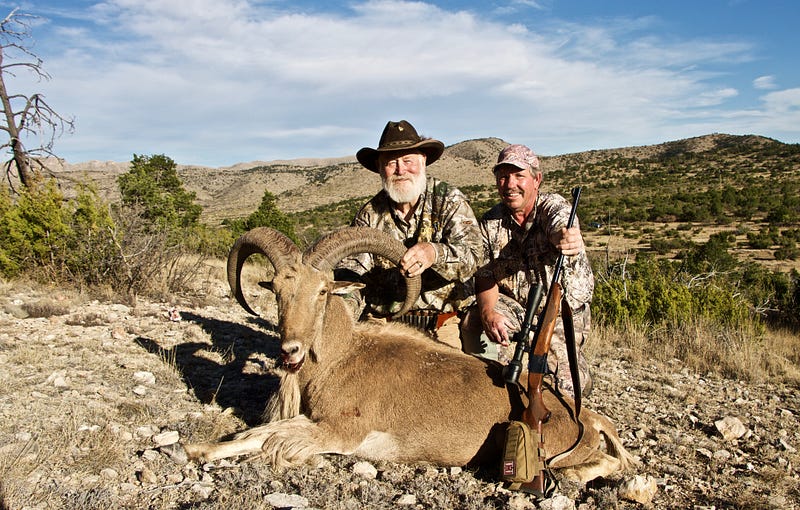
Photo credit: Larry Weishuhn Outdoors