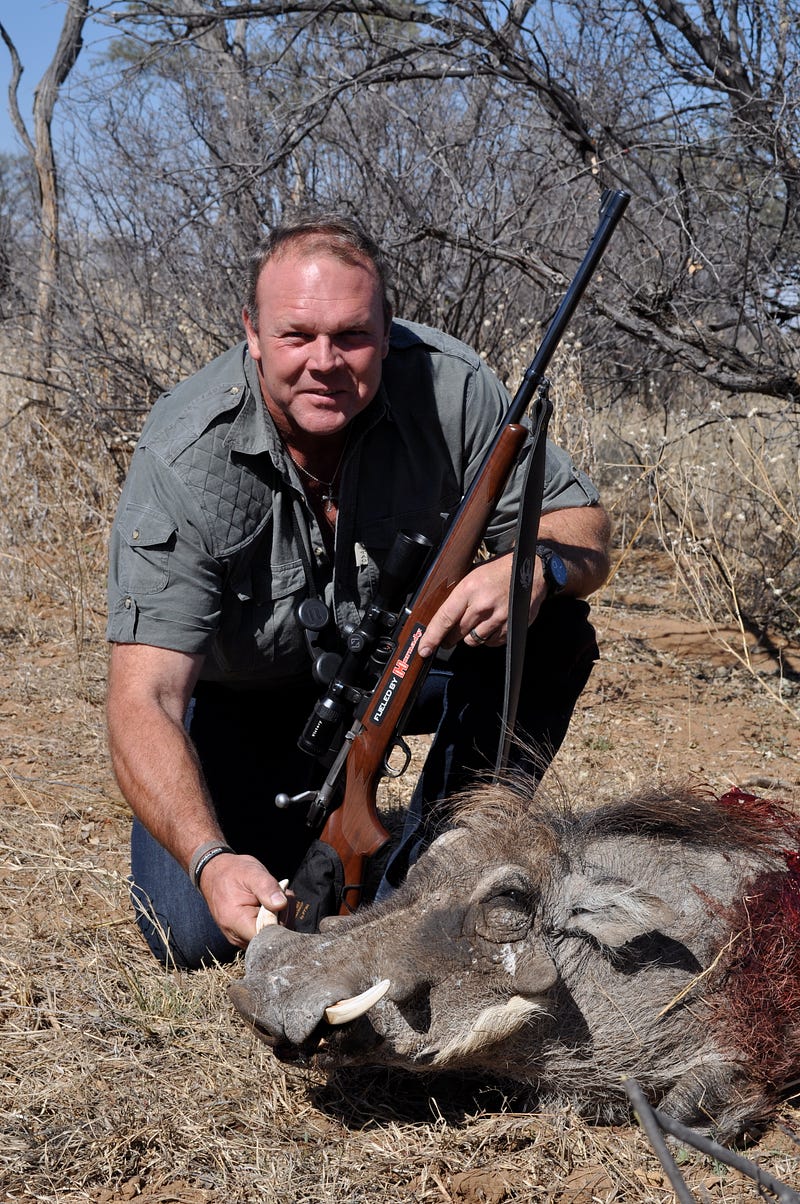
Wildlife biologist and outdoor writer Larry Weishuhn goes on the hunt for warthog in the Kalahari Desert of Southern Africa, to put food on the table for African trackers.
“Larry, the trackers wish us to shoot a pig. They’re proclaiming that they’ve gone far too long without the taste of wild pork, what say we go and comply to their wishes?” said my African PH Frikkie du Toit, as I stepped out of the pre-dawn cold darkness into his common eating area. Without saying a word, I nodded turned around and walked back to my most comfortable room, grabbed my Ruger 375 Ruger Guide rifle, Zeiss Conquest binoculars, a box of Hornady 300 gr DGX ammo and headed back to the warmth of the fire. I know that might sound a bit like a commercial but those are simply what I use when hunting in Africa. To me these tools make the perfect combination, whether I’m hunting dangerous game, antelope or in this instance, going after a warthog for the trackers’ larder.

“The coffee is hot and water is about to boil for tea. The toast, eggs and bacon will be ready in a few moments. While you’re waiting, warm up, as where we’re heading, we’ll be on the back of the vehicle, which will accentuate the chill. Mind you, where we’ll be hunting is about 20 or so kilometers from here and the property is lousy with pigs,” continued Frikkie, as I poured some coffee and watched it steam. Before leaving I also grabbed my Ruger American in 30–06, as well as a handful of Hornady American Whitetail ammo.
A few minutes later, Natasha, Frikkie’s gracious and beautiful bride, appeared carrying a platter heaped with toast, cheese, eggs and bacon, as well as fresh tomatoes and avocados and a pound of freshly churned butter. After a quick blessing, we partook of the delicacies, almost to excess.
As we finished Frikkie momentarily disappeared and I heard the vehicle start. He spoke something in the local dialect, followed by something in Afrikaans. I picked up enough words from his latter statement, which was a mixture of German, Dutch and local languages. With my knowledge of German, I understood he wanted the tracker to grab his double rifle and Ruger Hawkeye African in 375 Ruger, plus a handful of extra shells and double check that we had enough water and soft drinks in the cool box. He also suggested grabbing a bag of biltong (Africa’s version of jerky) and suggested that we would likely be out all-day long. Everything sounded perfect to me.
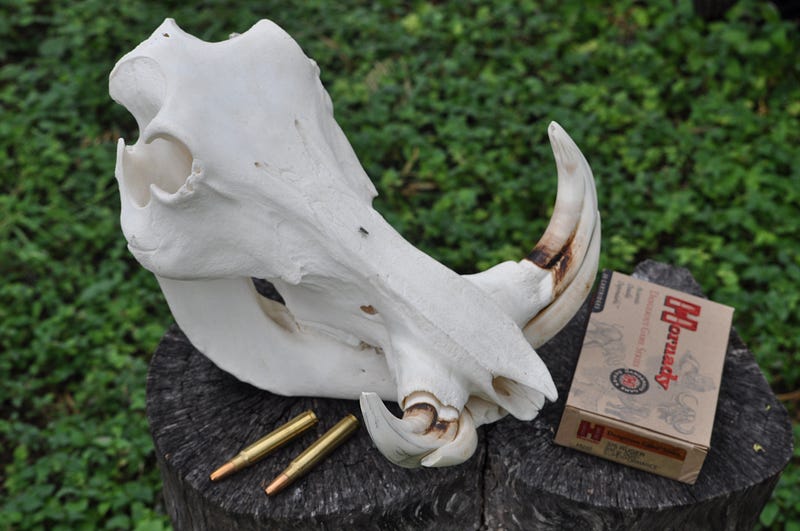
Life was good, I was back in Africa with someone who had become a good friend, with whom I had hunted African lion, hippo, kudu and other game species. Someone whose company I enjoyed and appreciated.
In some ways hunting warthogs is not unlike hunting javelina in my native south-western Texas. When you hunt for javelina, you can sometimes spend days in javelina rich habitat but never see one. However, when you hunt the same area for whitetail deer or even t-rex, they are in constant, continual sight, practically a nuisance! This was something we discussed as we sat on the back of the open rover heading to our hunting area.
It can truly get cold in southern Africa in July, as it’s their winter. Don’t forget how close southern Africa is to the South Pole.
“What say we alter our plans and hunt for desert bighorn sheep rather than warthogs, doing so, we should see litters of them,” said Frikkie with a wink. I nodded in affirmative, trying my best to hide as deeply in my jacket as possible.
The ride seemed longer than it was because of the cold. Finally we stopped at a gate and there waited for the landowner, a friend of Frikkie’s to show up with a key. While we waited, we started glassing. Off in the distance we spotted a small herd of kudu which included a pretty nice bull that we both estimated would go about 50 or 51 inches in length. In another direction we spotted several gemsbok and just beyond them, a herd of Burchell’s zebra.
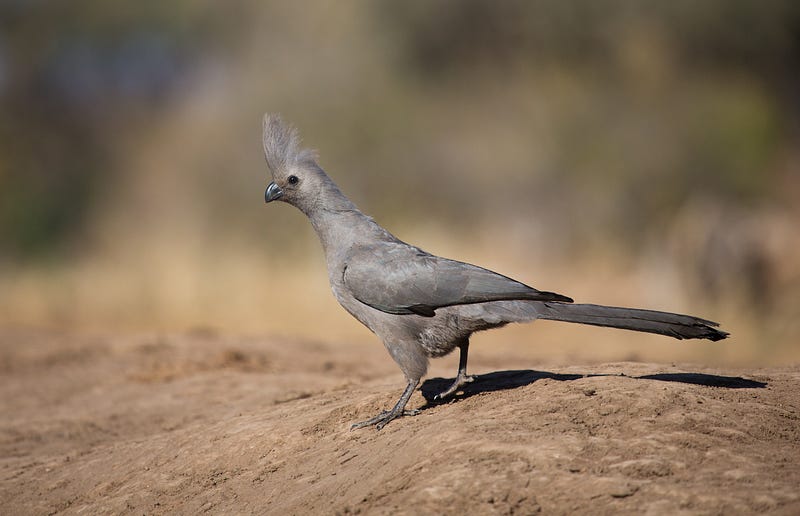
All around us we heard a great variety of birds. I could easily identify the sounds of guineas and the go-away birds and distinguish the cooing of at least two different types of doves, as prehistoric looking hornbills flew by. Off in the distance we heard the braying of a couple of donkeys, coming from the direction of a small village. All around the sights and sounds of the Kalahari Desert was coming to life.
“You know we’re probably not going to see any warthogs until about noon. Cold as it is this morning they’re going to be slow getting out of their holes, but we’ll look for some other animals early, then about noon get serious about warthogs, I mean desert bighorn sheep,” suggested a smiling Frikkie.
I remembered hunts in Namibia where I sat at a waterhole to see what would come to drink. Most of the time we would not see any warthogs until noon, then they showed up in good numbers until about three in the afternoon. They preferred the middle part of the day, possibly because of the warmth or perhaps that’s when predators were less active. In other areas where there were fewer leopards or lions, we had seen a lot of warthogs late in the evening. From what Frikkie had told me and from the tracks we had seen in the general area, this indicated that we were hunting where there were a lot of leopards and a few lions.
Hunting feral hogs in my home state of Texas, when there has not been any pressure put on them, it seems especially older, mature boars become almost totally nocturnal but in Africa very seldom do you see warthogs before sun up or after sun down.
I have been fortunate to have hunted African warthogs in several regions of South Africa, throughout most regions of Namibia, Zimbabwe and in north-western Africa in Benin. Interestingly in Benin, as in the adjoining country of Burkina Faso there lives a variety of red warthogs. When I first saw them, I thought they had been wallowing in red mud but our PH explained they were indeed a red-colored variety of warthog, which were found only in the two countries mentioned. My hunting partner Tim Fallon from the FTW Ranch and I hunted hard to find a red boar while in those two countries, but all we saw were red sows, with red pigs. Those we saw were as red as any domestic Duroc hog I have ever seen.
Back at the gate, Frikkie’s friend arrived with the key, opened the gate and told us of several waterholes where he thought we might find midday wart hogs, er… I mean desert bighorn sheep. He also told us to watch out for a particularly long-horned kudu bull. He believed a bull he had seen the previous afternoon had horns which might stretch 60 inches or more. That statement caught my attention, as for years I have been looking for a 60-inch greater kudu, I’ve come close with several bulls measuring from 55 to 59 ½ inches, but the 60-inch plus, to that point had escaped me.
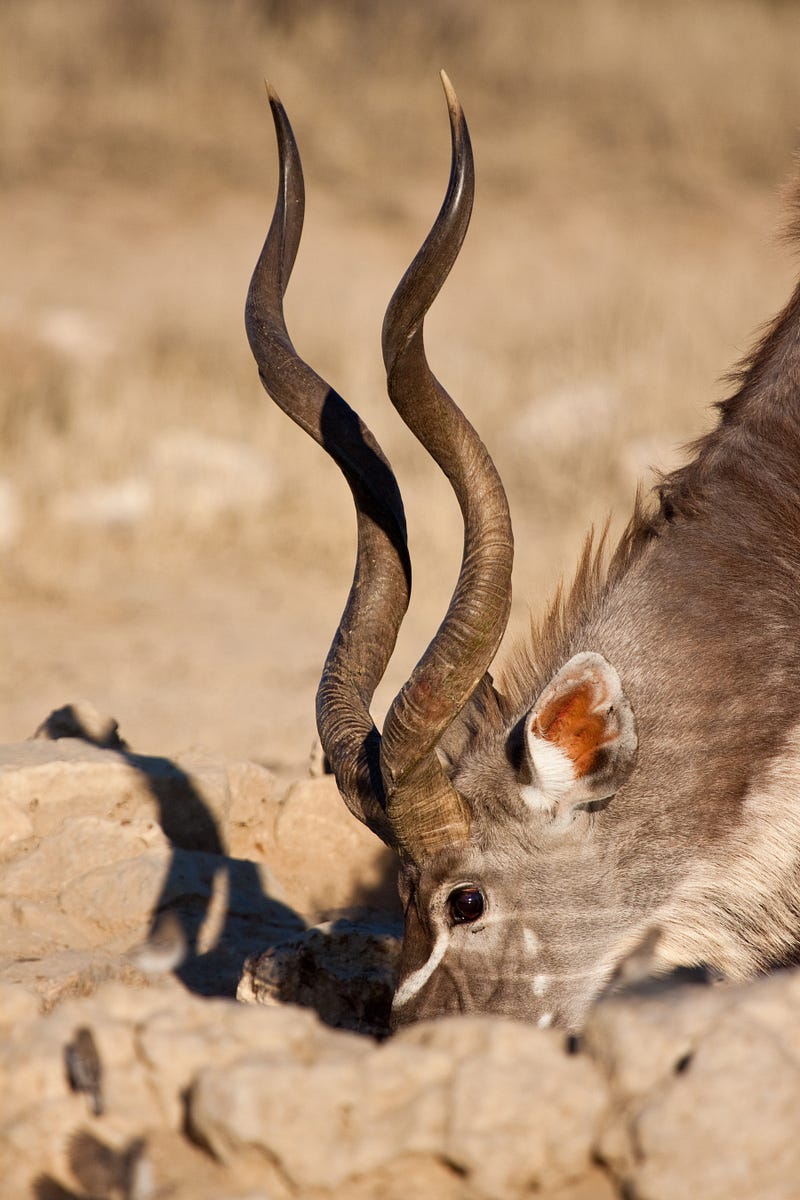
We spent a considerable time glassing various animals, including black and blue wildebeest, red hartebeest, eland, waterbuck, kudu, Burchell’s zebra, ostrich, numerous steenbok (one of my favorite small antelope) and a couple of gray duikers, but try as we may, we could not find any warthogs… I mean desert bighorn sheep.
As the sun rose, towards noon we drove to the different waterholes the landowner had suggested checking. We stopped on top of the first pond dam we found. Immediately we spotted a toothsome boar in tall grass, about 300 yards away and he was heading our way. We grabbed our rifles and shooting sticks, then headed in the boar’s direction. We cut the distance to within less than 100 yards. He was about to step clear of some brush. I set up the sticks and rested my 375 Ruger, the boar stepped clear, stopped and when he did, I tugged gently on the trigger. The boar dropped in his tracks. I bolted in another Hornady 300 gr DGX but it was not necessary. I glanced at Frikkie who was smiling, but notably the tracker’s smile was even wider.

While we took photos, the tracker walked to get the vehicle. A short time later we had the warthog loaded and started looking for another one.
Now it was Frikkie’s turn and it did not take long to find another boar. With the warming midday, the warthogs were moving. Frikkie’s boar was about 400 yards from the two track we were on. We started towards the boar but then Frikkie stopped, “What say I take a shot from here?” Back in Texas I had often shot my 375 Ruger not only at 400 yards but all the way out to 700 yards.
We discussed bullet drop at that distance, with the existing sight-in and ammo, then from shooting sticks Frikkie squeezed the trigger. At the shot his boar dropped in his tracks, we had two prime porkers down and sufficient pork for the trackers and their families.
We headed back to Frikkie’s headquarters where the two warthogs were properly taken care of. We spent that afternoon hunting close to home, looking for a big kudu. We saw numerous cows and calves as well as some young bulls, but not the big bull we were looking for.
That night as we sat around the campfire, we could hear a lot of singing and laughing coming from the direction of the trackers’ camp. All was well in our part of Africa.