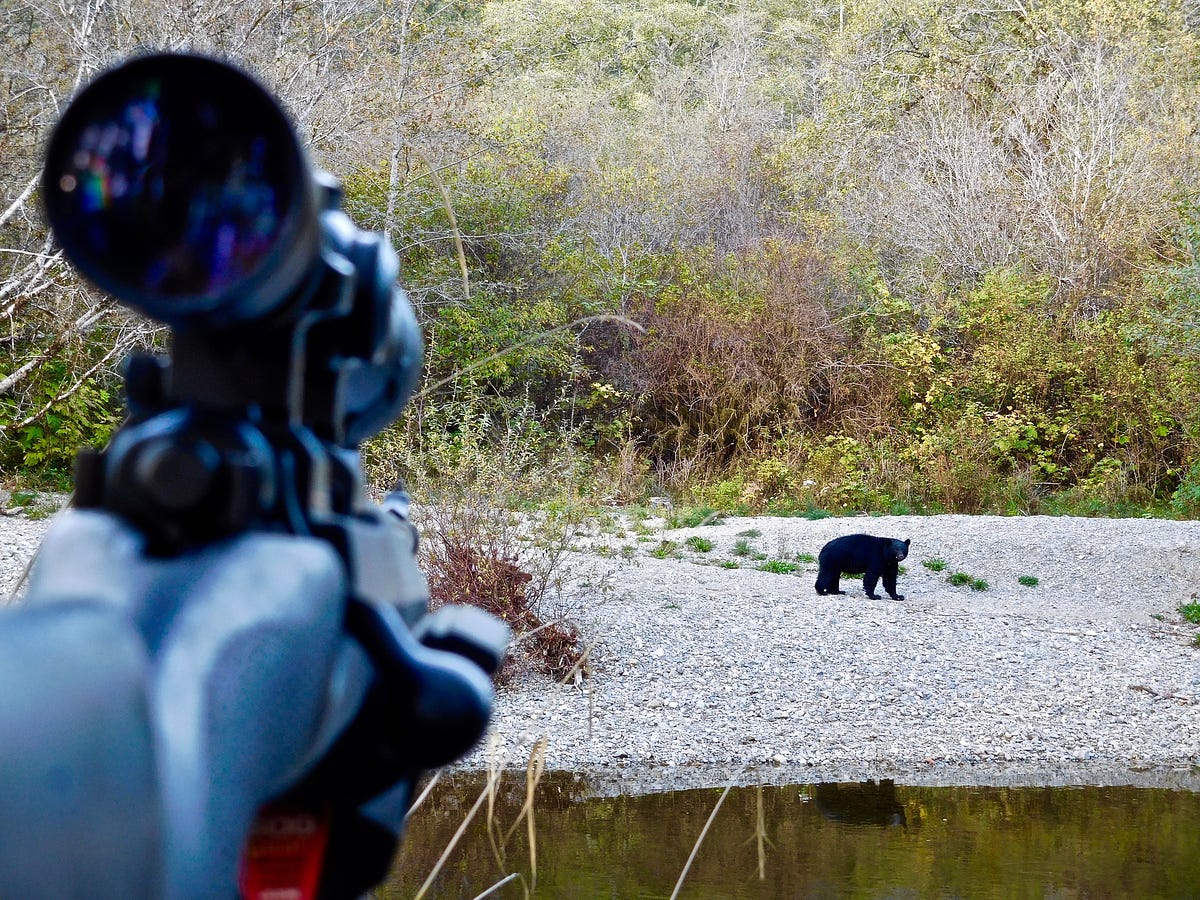
It was merely a black speck against a distant, verdant green slope. Could it possibly be a charred stump, or even a shadow, or was it a black bear? My 10x binocular was simply not powerful enough to make a determination. I shifted to the spotting scope next to me. I had set it up for just such a purpose. I started to focus on the distant black object. As I did, the black blob moved.
Stumps do not normally move, neither do shadows, at least not that quickly. I continued adjusting the focus and increased the magnification. Indeed, it was a black bear one of rather large proportions, compared to surrounding vegetation.
The bear fed hungrily on berries, sweet and plentiful. Not long out of hibernation no doubt he was trying to fill a huge hollow space in his stomach. As a cloud passed sunshine accentuated his glistening black hair coat, giving it an almost indigo sheen. He was a mile away. But thankfully many daylight hours remained. If I stayed on top of the ridge where I was, with a bit of luck and truly “hoofing it” I could stay above him and possibly get a shot before he left what appeared to be a relatively open slope.
I glanced at my companion, Jim McCarthy with Jim McCarthy Adventures. Jim had set up the hunt for me in British Columbia. He was smiling and obviously reading my thoughts. I did not have to say a word as I, with some urgency, gathered gear into my back pack.
We took off at a fast walk. Thankfully the ridge we were on, which formed a great bowl, was relatively easy walking. Even so it took us nearly an hour to reach the immediate area near where we had last seen the bear. Walking to the edge of the ridge, I peered over its side. A large black bear was 300 yards below. I had feared the terrain might stair step and prevent me from seeing the bear quite so easily or quickly.
I studied the bear through my binoculars. He was still greedily feeding on the abundant berries. I was almost certain indeed the bear was a “he”, based on his wide head indicating heavy jaw muscling. Too, he had rather thick forelegs right above his ankles/feet. Female bears seldom have what looks like a slight valley or furrow on the top of their heads because of heavy jaw muscles as this bear did, nor do they have heavy-set forelegs. Having had at that point shot several black bears, I knew he was mature and also the biggest bear I had seen thus far on this particular hunt.
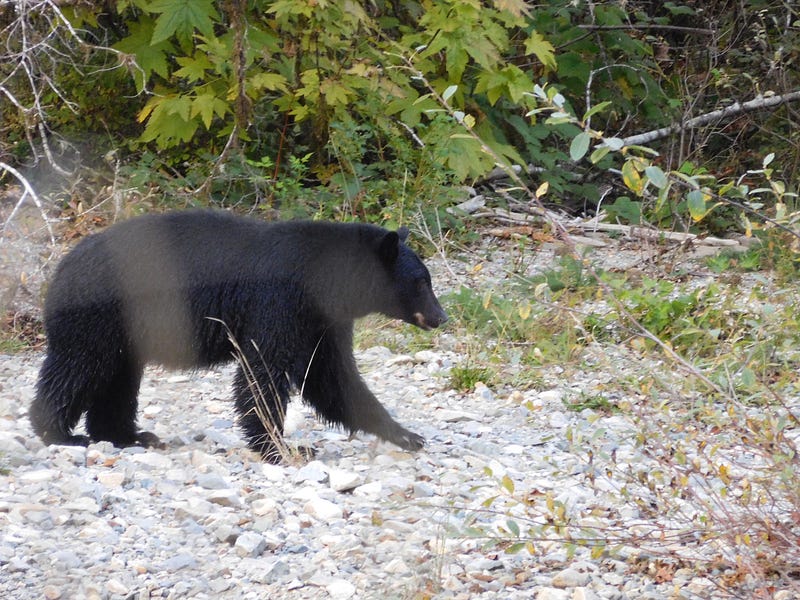
“Think he’ll square six and a half feet?” I asked of Jim, who was now also looking through his binoculars. The “square” of a bear’s hide refers to after the skin has been removed and laid flat on the ground, then measuring from the tip of the tail to the tip of the nose. This measurement is added to the measurement from the tip of the claws of the left front foot to the tip of the claws of the right front foot. These two measurements are added together then divided by two, giving the square of a bear.
“He should be at least that!” Replied Jim. “He looks like he has a big head as well. His skull should measure at least 18 inches. But as you know judging skull size is a tough and at best a rough guess.” Record keeping organizations measure skulls, completely cleaned and dried. To measure a bear’s skull as it is officially done means removing the lower jaw and placing the skull on a flat surface, then using two 90-degree angle blocks, place one at the front and one at the back of the skull, then measuring the length between the two to an eighth of an inch. This measurement is added to the width, which is determined by putting a 90-degree angle block on each side of the skull on the orbital bone at the widest point. The total of the two is the bear’s score. Frankly anything over 18-inches is a really nice black bear. To make the Boone and Crockett all-time record book, the minimum score is 21 and that is a huge headed black bear.
Interestingly just because a bear has a huge body that squares a lot does not mean it will have a really big skull. I have taken bears that squared almost eight-feet and weighed near or over 500-pounds that had skulls that measured between 19 and 20. I have also taken bears which squared around six and a half feet that had skulls approaching 21-inches.
Back in British Columbia… I cut the distance to 100 yards by keeping the wind blowing from the bear to me. Black bears have reasonable eyesight and hearing and an excellent sense of smell. The reason these days when hunting bear or for that matter any other game, I spray my clothes thoroughly with TRHP Outdoors’ Scent Guardian.
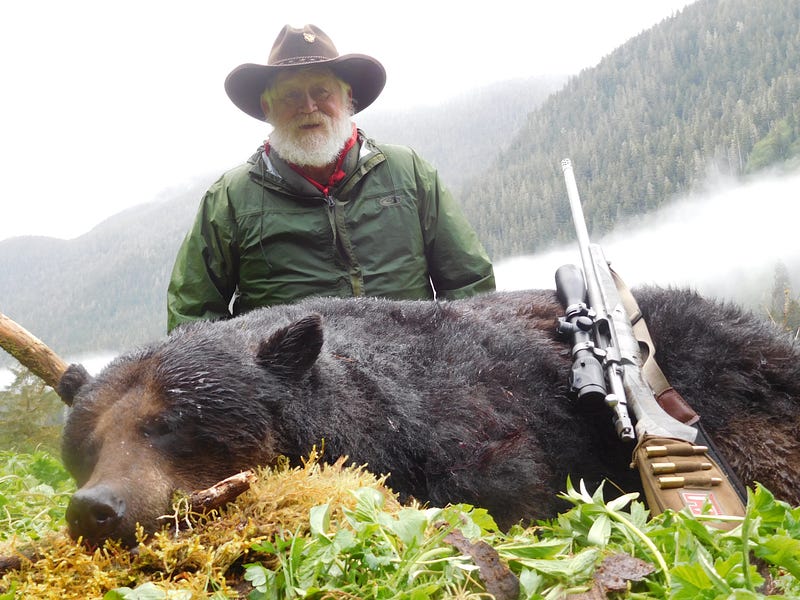
I removed my backpack to use as a solid rest, slid a 180-grain SP Hornady round into my 300 H&H Mag Ruger №1, peered through the scope and when heart rate returned to normal, I gently pulled the trigger to place my bullet through his slightly quartered to me, onside shoulder and drive it through his vitals. At the shot the bear bolted, but ran merely 10 steps before it went down. I quickly reloaded and kept my rifle trained on the down bear. If he made any attempt to rise, I planned to shoot him again. He did not move.

Minutes later I was at the bear’s side. He had a gorgeous, luxuriant black coat, was wide of head and was indeed an older boar, whose teeth were severely worn; the perfect black bear to take. After photos we skinned, then quartered the bear. Skin to later be shipped to Double Nickle Taxidermy, meat to be ground and used primarily for various flavorings of sausages.
That was a few years ago. My most recent black bear spot and stalk hunt occurred in Southeastern Alaska. On that hunt I used my 375 Ruger Guide rifle topped with a Trijicon AccuPoint scope, to me the ideal optic to use when hunting black bear, and shooting Hornady 300-grain DGX ammo. That combination to me, is THE ideal caliber/round, rifle, scope and ammo combination when it comes to hunting black bear. However, just about any rifle used on whitetail deer will also bring down black bear. Hunting black bear spot and stalk I have taken them using caliber/rounds from 257 Roberts to 450–400 NE 3”, as well as 12-gauge shotguns, 45 and 50 muzzleloaders, and a variety of handguns from single-shot 308s to 500 S&W Magnum 300-gr FTX. Did I mention I like hunting bears?
Shot placement on bears is a bit different than whitetail deer. Bear vitals are situated somewhat forward compared to deer. There are several excellent sources available to study bear anatomy, which I do frequently and suggest other hunters do as well.
All this thinking about hunting bear is making me want to load up and go spotting and stalking black bear. How about you?