The plan was a simple one. Meet at the rifle range, shoot a couple of rifles and then head to the woods to look for shed antlers.
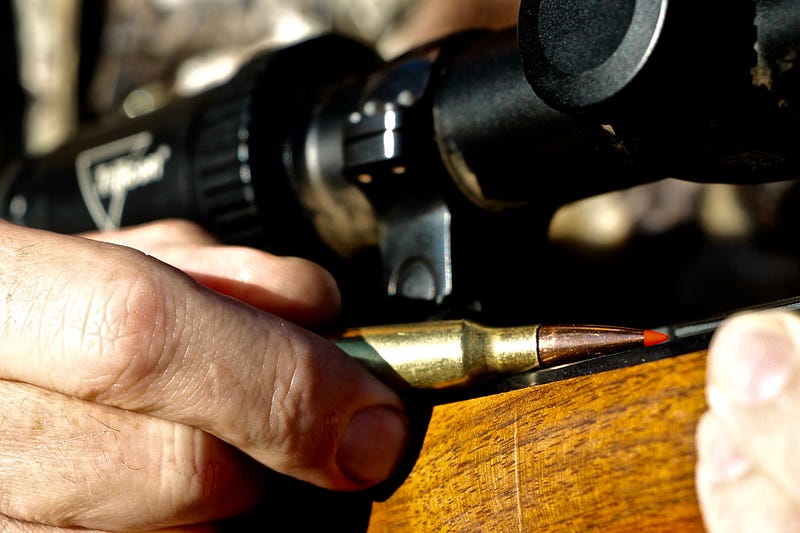
“You’ve got a nice group going. Your three shots are all touching forming a clover leaf,” commented my brother, Glenn, peering through our spotting scope. “I’d say you gotta choice. Quit now with a group that looks like one ragged hole… or, shoot two more rounds and hope you don’t screw up your tight group. And it would be you, because it looks like your 6.5x55 Swede likes that Trijicon Huron scope and those Hornady 140 gr. SST loads!”

The 6.5x55 Swede loaded with Hornady 140 gr. SST Superformance
His points were well taken. If I stopped now that tight group surely would make a pretty photo. And with that sort of accuracy, there was no reason to shoot more than three times.
If an animal did not go down immediately with the combination, I would indeed try to put another round into the vitals, albeit at a different place than the first shot.
I am one who believes in shooting follow-up shots, but not placing my bullet in the exact same place as the first shot. Using good non-solid bullets, those produced by Hornady open a substantial wound channel. Placing a follow-up shot into the nearly exact place does little more than possibly (heavy on the “possibly”) create a slightly bigger wound channel, and would likely do no more damage than the first shot. Given a second or third follow-up shot, I always try to place that bullet through a different part of the vitals, creating a second and/or third wound channel.
Knowing my rifle was dead on at 100 yards, rather than shooting two more shots at that target, I decided to shoot the 200-yard target. Those two touched and were just below the center of the one-inch bullseye.
If ammo were easier to come by, I might have continued shooting, but with the current ammo situation, I decided my remaining bullets would best be used putting holes in game for the table, rather than punching holes in paper!
I bade my brother a good afternoon and headed to the deer woods in hopes of finding shed antlers and maybe seeing some deer. Late March through to May are the most boring months when it comes to the world of deer hunting, in my opinion. Thankfully there is shed hunting, because bucks for a while during early summer look not a whole lot different than does, other than their “starting” antlers. Even on big bucks, there is not much to look at in the growing antler department until their second and third main beam tines are obvious. Yeah, there is a hint at possible mass early on, but for a while there is not really much to look at.
Looking for sheds is something totally different. Even when in the field by myself having spotted a big cast antler I find myself running to where it lays, not unlike having to race them to the shed to claim it.
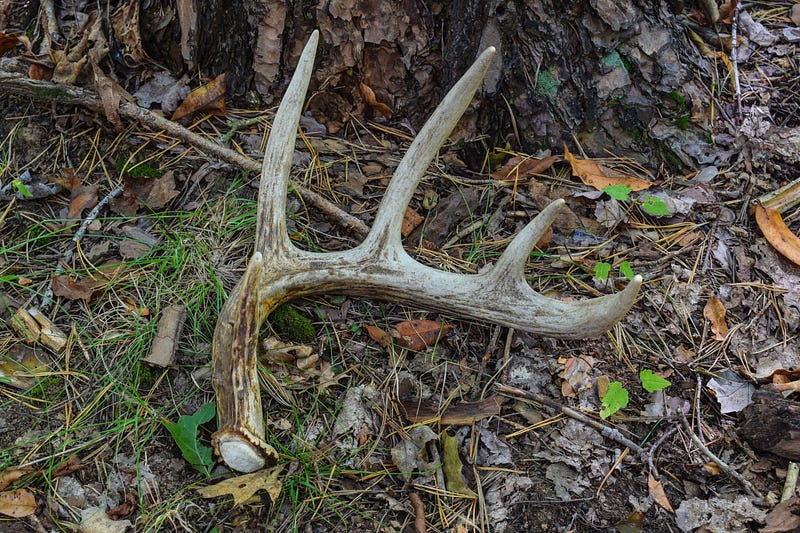
While looking for sheds, hopefully those which have only recently been dropped or cast, I also look for those which have been laying around for a couple of years or longer. Finding somewhat possibly chalky outer surface sheds, I look to see if they have been chewed on. Chewed on by mice, rats, squirrels, rabbits as indicated by small teeth marks. These smaller mammals chew on shed antlers for calcium, phosphorous and trace minerals. If older sheds look like they have been chewed on by deer or even cows, denoted by larger chewing marks, this tells me there is likely a lack of calcium, phosphorous and other minerals in the local soils and vegetation. Should I find several chewed on shed antlers, if local state regulations allow, I will look for places where I can set up man-made “natural” mineral licks.
To do so, I will dig a shallow hole, alongside a well-traveled deer trail. If baiting is legal in the area, for two or three weeks I pour shell corn into the hole to get deer coming to that exact spot. Once the deer know that spot holds things of interest for them, I pour a sack of commercially purchased mineral mix into the hole and throw a few kernels of corn on top. After that, I simply visit the lick-site every few months and if necessary, replenish the mineral.
On the properties I have managed in the past, we often saw a peak in mineral lick usage during the spring months, when does are trying to grow their unborn fawns and bucks are trying to produce antlers.
There are numerous commercial deer minerals, all for the most part work. The things I look at in these mixtures are primary and trace minerals, but also the salt content. In areas where soils tend to be saline, meaning higher salt content, I use minerals with a lower salt content. Where soil tends to be low in salt, I use mineral mixes which have a higher salt content. Following this regimen has worked well for me.
Do supplemental mineral licks help deer to any great extent? Frankly in my opinion it is a toss up. I have however, managed properties where once we added mineral licks, deer seemed to be healthier and develop bigger antlers. But minerals were and generally are not the magic bean or answer-all. We too, on those properties through a variety of ways, increased daily quality food availability and allowed bucks to mature before putting hunting pressure on them. To me, minerals were and are simply another cog of the wheel to success.
Some states have outlawed any kind of salt or mineral supplementation because of concerns about chronic wasting disease. Before you consider setting up a mineral or salt lick, be certain to check your local state regulations.
The spring is a great time to spend time outside, even if a little boring not having antlers to look at!