Pigs and Predators in the Noisy Bird Mountains
8 min read • 22 May, 2026From preparation to pursuit, the story continues in the Kiamichi Mountains of Oklahoma. Following on from Getting Ready for a Very Special Hog, Dr. Mike Arnold finds himself immersed in fast-moving encounters and long-held ambitions, as a planned hunt for a rare feral hog unfolds into something broader. With Hornady bullets put to the test in the field, the account moves from the sudden rush of a sounder at close range to a hard-earned first coyote, blending fieldcraft, biology and the unpredictability that defines predator hunting. It is a reminder that even the best-laid plans can open the door to unexpected moments in wild country.
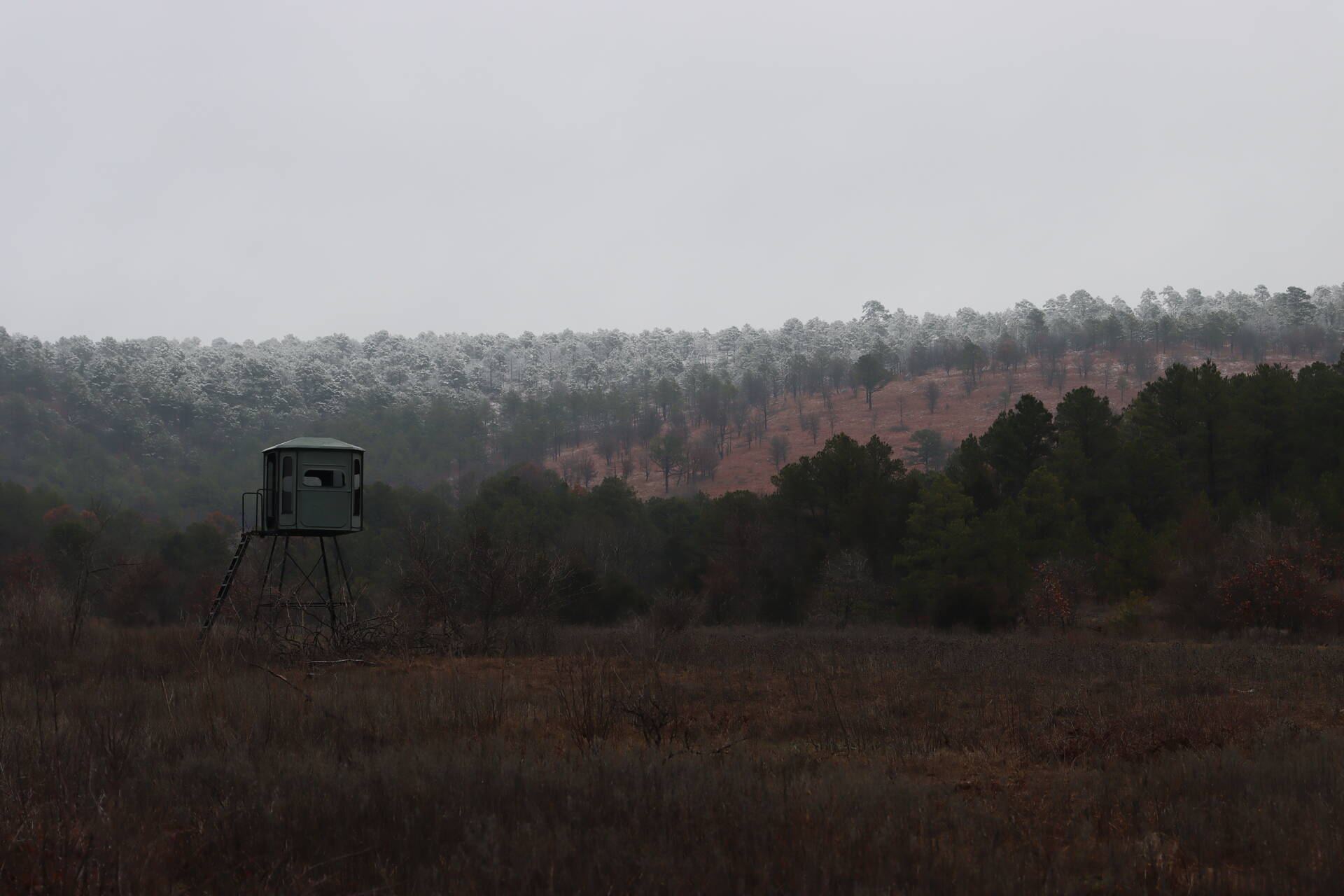
It happened with the ‘whoosh’ of floodwater cascading down a creek bed. But this whoosh contained a seething mass of snouts, cloven hooves and flopping ears. One second the herd of feral hogs wasn’t there, the next they entered from stage left like a squealing tsunami. I was on a property within the mountains named by local Indian nations, including my wife’s ancestors, the Choctaws, Noisy Bird, a.k.a. Kiamichi. To nerd-out a bit, the various ‘loud’ bird species mentioned as possible catalysts for the naming of this mountain range include, Whooping cranes and woodpeckers. One other candidate is the so-called, Horned Screamer, Anhima cornuta. If the latter species is the basis for the nom de plume of the Kiamichi Mountains, it must have come originally from a tribal member who went to South America for vacation, or more likely, a European who’d spent time in those tropical climes. The Horned Screamer doesn’t make it into Central America, let alone Oklahoma. Regardless of which noisy offspring of the dinosaurs gave rise to their name, the Kiamichi mountains were the beautiful backdrop of my hunt for both the feral animals feeding in front of my ground blind, and my first ever coyote. More about the coyote in a bit.
I slowly raised the MG Arms Ultralight to its rest on the 4StableSticks ‘Sit Stick’. The rifle is my so-called ‘pet’ that I’ve used to take everything from a Namibian leopard to a Georgia whitetail. Chambered in 7mm Remington Magnum, it carried my handloads topped with Hornady 162-grain ELD-X bullets that, on past hunts, accounted for a Mountain Zebra, Roebuck, Sable antelope, and more. I was interested, if the chance came, to see how the rifle + bullet would do on a tough-as-nails, feral hog.
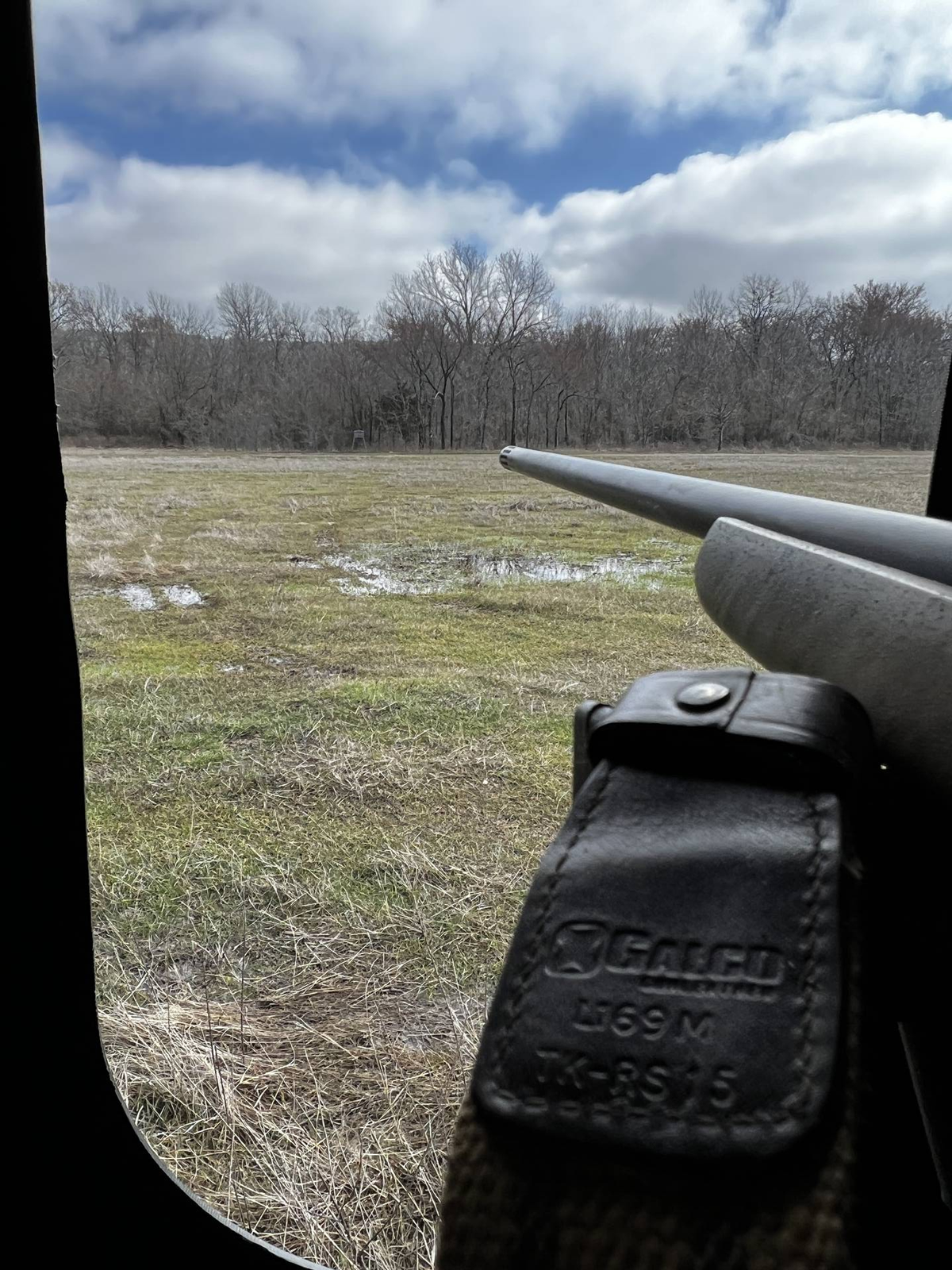
When Eric, my outfitter and guide, dropped me off at the pop-up blind some two hours earlier, he mentioned that there was a big boar, spotted on the trail camera near the automatic feeder, routinely turning over the metal box to get to the corn. He asked me to focus on that animal, if he came in. If he did not, but other pigs did, he told me to shoot the largest animal. As I studied the animals with my binocular, I saw no sign of the black boar described by my outfitter among the 20+ pigs. I hesitated for a minute or two, hoping that he would make an appearance. He did not. However, a very large sow with swollen teats muscled her way through the other hogs, demonstrating a dominance often seen in older, and larger animals.
As a biologist, I understand that the biggest effect on population numbers comes when selective harvesting of females occurs. Basically, as with humans, males are a dime-a-dozen, while females are not. With this in mind, I placed the crosshairs onto the shoulder of the side-on animal and squeezed the trigger. The squealing heard when the animals entered my view was nothing like the roar they made as they stampeded for the safety of the treeline. At the report of my rifle, I’d seen the sow drop and kick a few times before becoming still; dropping the sow in her tracks demonstrated again the effectiveness of the rifle and Hornady bullet.
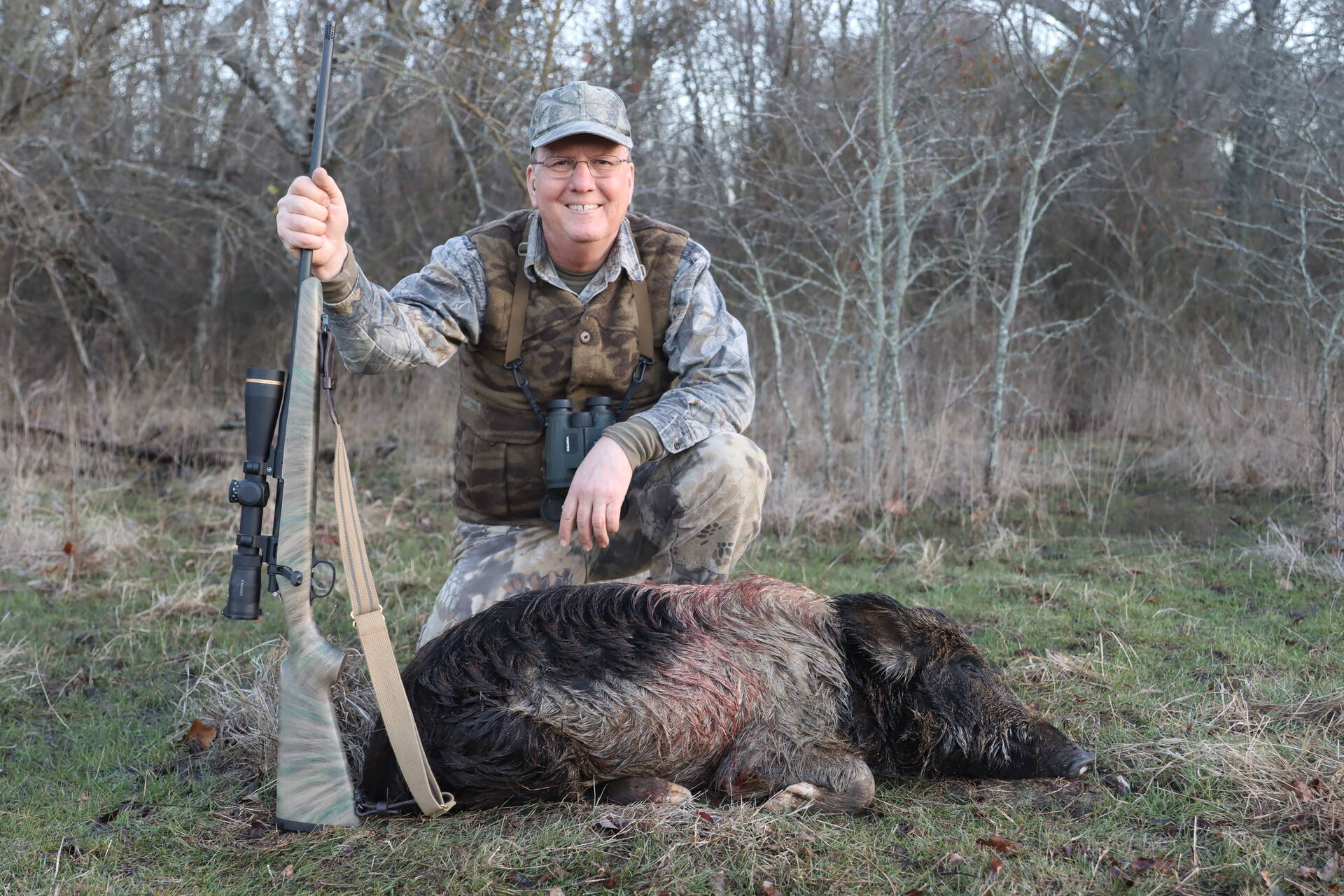
The sow had beautiful white and black markings similar to domestic Hampshire hogs. Rolling her into the posture for photographs was a bit difficult, but right after I texted my outfitter to come and get me, I used the self-timer on my camera and phone to snap the requisite trophy shots. I’d only taken one other feral pig, a young one, some 20 years earlier, with a .38 special Colt revolver. This female definitely dwarfed that first animal, which was why Eric and I grunted and groaned when we lifted her into the back of his 4-wheel drive buggy. As we bounced our way toward the lodge, I reflected on the fact that I love hunting ‘pigs’, whether African bushpigs, Javelinas, Warthogs, or the sow ensconced in the back of Erik’s four-wheeler. Before you ask, I have no idea why that passion is there. It’s the same with ‘cats’. I love equally the memories of my hunts for bobcat, mountain lion, and leopard. Ironically, I am much fonder of domestic cats than dogs…go figure…
Speaking of dogs, the next item on my species wish list was one I’d spent a lot of time listening to while growing up near Abilene, Texas. Hearing the barking and howling of coyotes, Canis latrans, was a common occurrence when we sat in lawn chairs in our backyard drinking coffee or iced tea while watching our horses grazing in the fading, evening sunlight. The horses were unfazed by the music, while our cats and dogs seemed to understand they were listening to very efficient predators that viewed them as a potential meal.
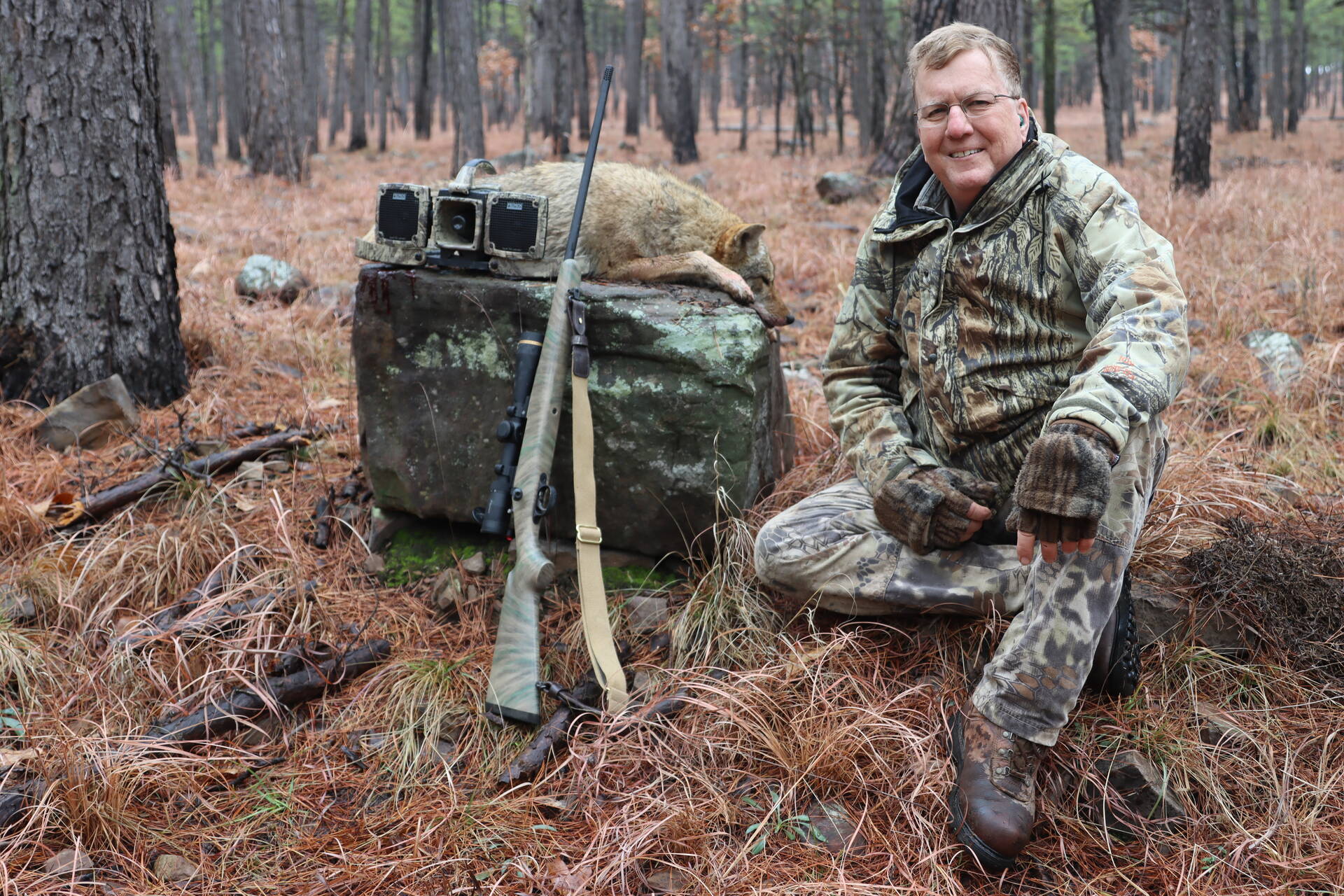
As Eric and I headed back into the Kiamichi landscape the next day, just as the sun began lighting up the winter landscape, we did so with an electronic caller in tow. Stopping where the hillside met the creek bottom, we grabbed our gear and slowly began our trek to the site of our first ‘set’. We arrived 30 minutes later. Eric set out the speakers, while I settled into a comfortable sitting position. Right at 7 am, Eric began cycling through the distressed pup, feeding, etc. calls. Three hours later, we were some four miles from the parked buggy, on the sixth set of the morning. Over the three hours Eric traced out a circuitous path leading further up the rock-strewn hillsides. The coyote choral music had yet to result in an answering call, or sighting. I was fairly discouraged, and a bit weary from lugging my gear up-and-down the Noisy Bird slopes. I sat with my back against a pine tree, a camouflaged balaclava covering my pale face, with my rifle resting across the same Sit Stick used for the hog hunt.
At the end of the series of calls, I heard the slight rustle indicating Eric standing and picking up his gear. I lifted the rifle from the rest, letting the Sit Stick fold back into my chest. As I prepared to leverage myself out of my sitting position, I heard a sharp intake of breath from my guide. His hand pressed me back down as he whispered, “There are two coyotes just over that rise!” Although not more than a few feet in height, from my seated position, I could not see the canids moving back-and-forth on the opposite side of the knoll. I settled myself again, back against the same tree, rifle steady on the rest, searching through the riflescope for any movement. While I worked on getting back into position, Eric let loose with a series of calls trying his best to entice the animals onto the top of the hillock.
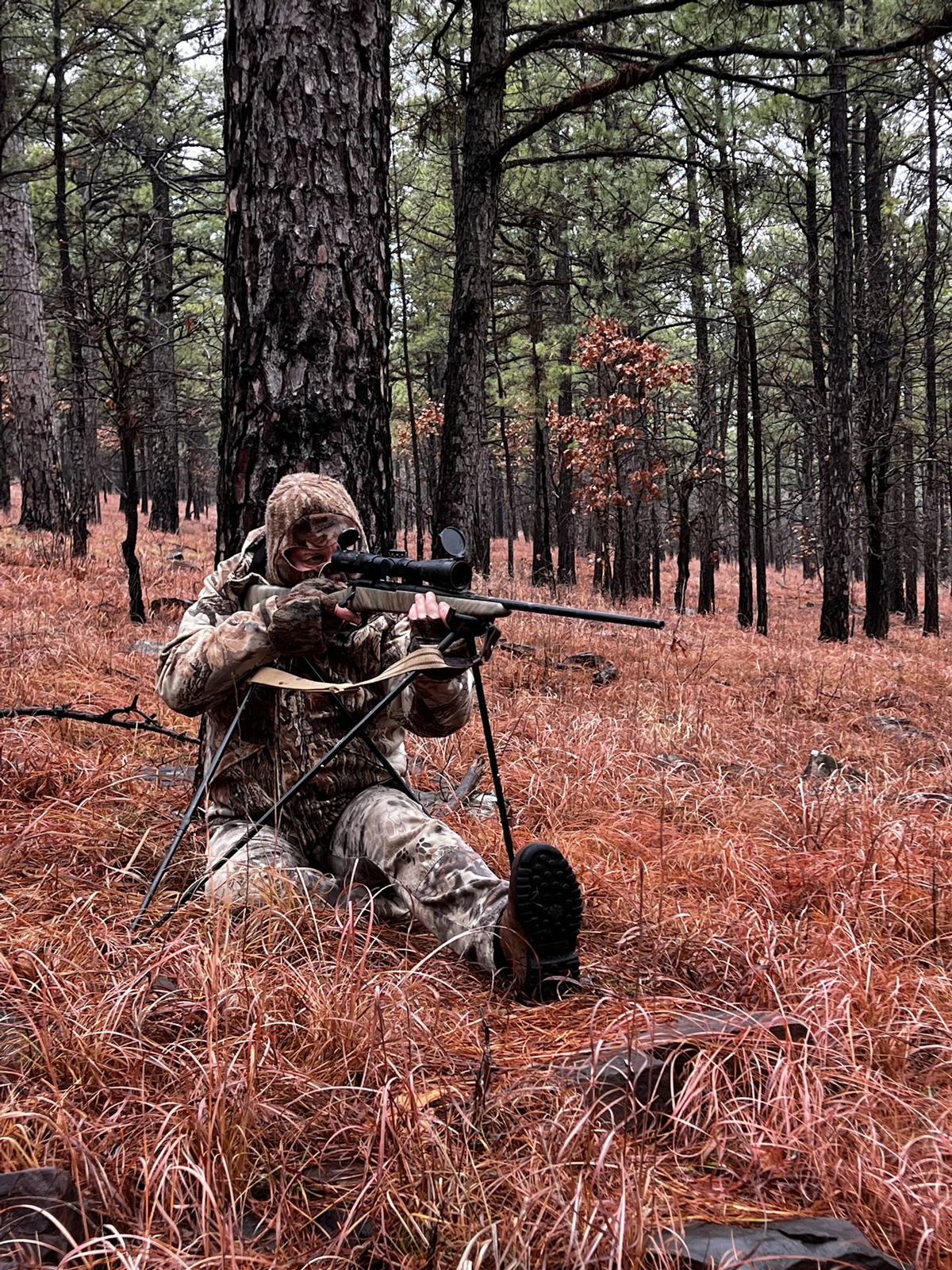
After five minutes, Eric said, “They’re gone.” My heart sank, but as I glanced right, I spotted movement among the pine trees. Eric noticed the same motion, and with his trained eyes, realized it was a third coyote heading in our direction. The trotting animal’s course, if continued, would lead to a small opening between two trees. Placing the crosshairs in the middle of the coyote-length break in the forest, I waited. As the animal appeared at the edge of the field-of-view I squeezed the trigger. With the muzzle brake preventing barrel lift, I saw the animal collapse on the spot. Eric clapped me on the back stating “Great shot!” I smirked up at my guide and countered with, “Lucky shot!”
As we made our way down to my first-ever coyote, I stopped and looked around at the landscape. The Choctaws named this place, Kiamichi. I knew that hunter-gatherers, like the Choctaws, always lived in a precarious balance between plenty and want. Yet, I could not help but imagine that they too, in years past, stood on this very slope and felt blessed to be witnesses of the beauty of the land they called Noisy Bird.
Author profile
Mike Arnold is professor and Head of the Department of Genetics at the University of Georgia and author of the 2022 book, BRINGING BACK THE LIONS: International Hunters, Local Tribespeople, and the Miraculous Rescue of a Doomed Ecosystem in Mozambique. Mike’s newest book, BRINGING BACK THE WILD – Stories from Revitalized Ecosystems Around the World and How Sport Hunting Supports Them, appeared in June 2025.
You can find a description of Mike’s travels, talks, articles, and books at mikearnoldoutdoors.com.