England's Vampire Deer
10 min read • 08 May, 2026Some deer are known for their antlers, others, for something far more unusual. In this edition of The Hole Story, Larry Weishuhn takes us into the English countryside in pursuit of muntjac—small, elusive deer better known as “vampire deer” for their sharp upper canines. What follows is a story shaped by decades of curiosity, chance encounters and time spent in the field, where history, habitat and instinct come together. From first sightings to a long-awaited shot, it’s a reminder that some of the most compelling hunts are those driven not by size, but by intrigue.
My hunt in England had been an interesting one. It started with a visit to the Holland & Holland store in London, admiring guns I could only dream about and hold momentarily. Admittedly, I did get a bit of special treatment. At the time I was the hunting editor for Shooting Times magazine back in the States. As such, I got to see guns being built and even got to shoot a couple of gorgeous double rifles. If I sold my home back in Texas, plus all the guns I owned at the time, I could have come up with the down payment for the one I really liked that had been built for a Middle Eastern prince.
My primary purpose for being in England at the time, now nearly a lifetime ago, was to hunt and hopefully take a really nice roe deer buck.
My host, Merwyn Manningham-Buller, and I were slowly walking a trail through dark woods, previously, hundreds of years ago, tread upon by the knights of old. “What was that?” I questioned. We were hunting near Castle Corfe, built in the 11th century by William the Conqueror. “Couldn’t have been an apparition or ghost. I don’t think it was a fox—wrong colour and too big and heavy. Looked somewhat like a miniature deer, smaller than a roe. Just caught a glimpse as it ran across the trail up ahead.”
“I do believe you just saw a muntjac! A unique little deer now found over much of our part of England. Reeves’s muntjac, to be proper. Brought here from Korea and China back in the late 1800s. Did it have antlers?” commented Merwyn.
I wagged my head in a negative manner.
“Must have been a doe. If we do see a buck and you are interested, you’re welcome to take it. They are considered invasive here in England.” I silently hoped we would see another buck; unfortunately, we did not.
Back in the late 1970s was the first time I had heard of Reeves’s muntjac (Muntiacus reevesi), sitting around a hunting campfire listening to the stories told by Bert Kleinberger. Bert, with his brother Chris, hunted throughout the world beginning during the late 1950s. They opened numerous countries to hunting after the close of World War II.
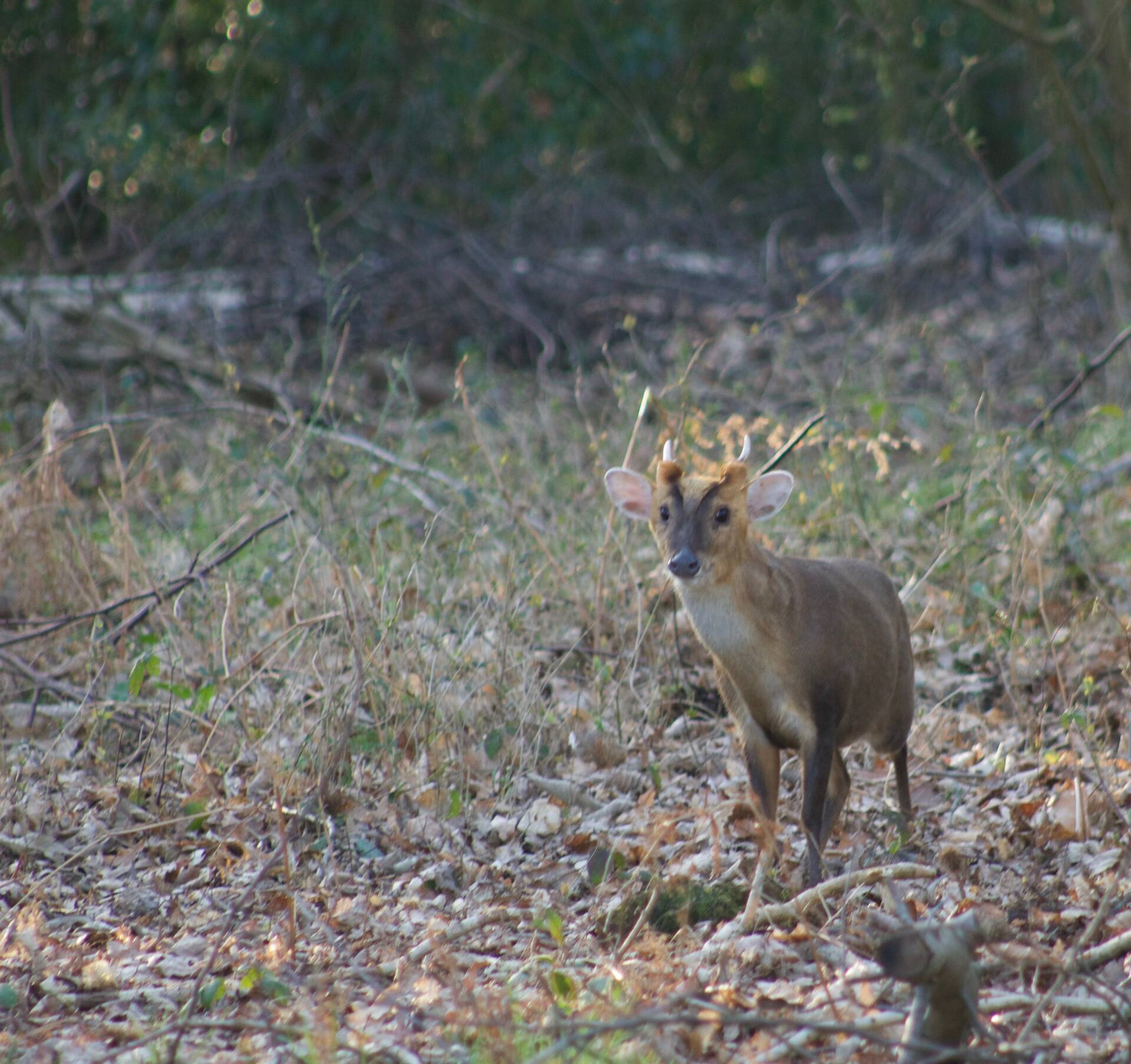
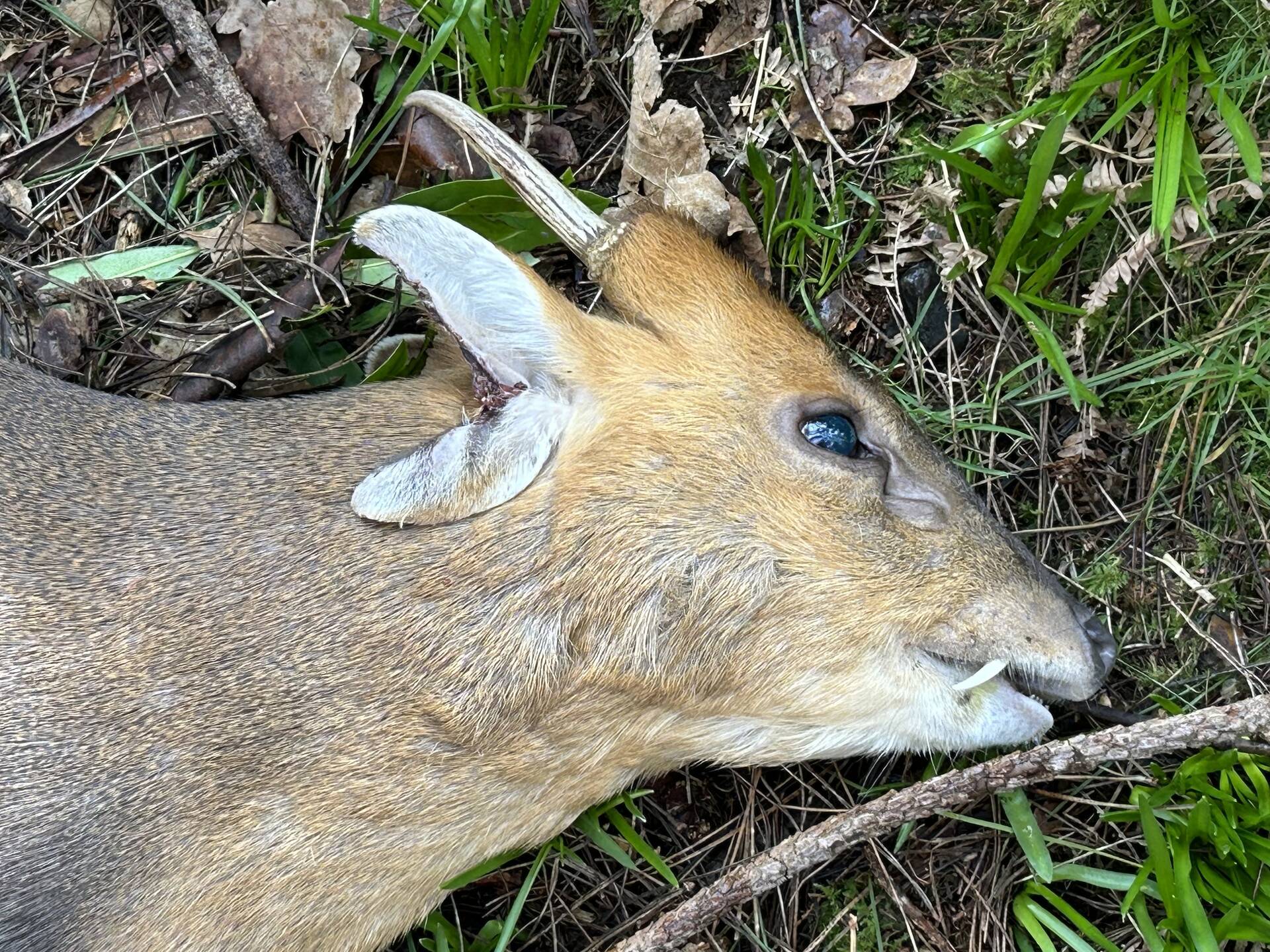
Said Bert, “Muntjac are a little bigger than a Beagle hound. Bucks have antlers, upwards of three inches long; some have short brow tines beyond a spike main beam.” He continued, “The bucks have fangs—long upper canines about two inches in length—truly unique! One of our guides in southern Asia back then called them ‘vampire deer’.”
Muntjac, sometimes called “barking deer” because of their dog-like bark, can supposedly still be hunted today in some of their native lands. But England has also become home to substantial wild populations. There are also Reeves’s muntjac on a few Texas exotic hunting ranches. I could have taken one in Texas, but I longed to hunt them in a true free-range setting. England was my best option.
Since first hearing about them from Bert Kleinberger, I had longed to hunt “the vampire deer.”
Fast forward several years. John Landgraf and I were visiting with Stefan and Sofia Bengtssen of Scandinavian Prohunters at a DSC Annual Convention and Outdoor Expo, discussing our upcoming moose hunt with well-trained dogs in Sweden, followed by hunting whitetail deer in Finland.
“You should come to England with us and hunt the fanged deer—Chinese water deer and muntjac. Fun hunt!” suggested Stefan.
I had previously hunted several times with Stefan and Sofia for red stag in Scotland and Sweden, fallow deer in Denmark, reindeer in Norway, as well as roe deer and shooting waterfowl in Sweden. All my hunts with Scandinavian Prohunters had been perfectly orchestrated and executed, and I truly enjoyed their company and loved hunting with my two friends. That said, the moose hunt John, Bruce Keller and I did in Sweden, and the whitetail deer hunt in Finland, could not have been more fun, enjoyable, or successful.
“OK!” said John. “We’ll hunt fanged, vampire deer in England in 2026. Can we do it in early March? Our Texas deer hunting season ends the last day of February. That OK with you, Larry?”
Stefan and John both knew my answer without my uttering a word. Moments later, we had booked our hunt.
Back in England, with Chinese water deer “in the salt and the larder,” Stefan and I headed to the property where a rather long-antlered muntjac buck had been seen. John headed to a high seat in the forest. Our stalk produced one muntjac doe, not the buck we hoped to find.
Later that evening, John and I hunted with our previous guide, Adam Gage. After walking a considerable distance and having seen numerous Chinese water deer, we sat to watch an area near tall trees and underbrush. As we waited, I asked Adam about muntjac.
He responded, “As you know, they have both antlers and fangs and are highly reproductive, to the point we have to control their numbers to prevent habitat destruction for other species. They, too, are a very primitive deer, dating back to the Miocene, more than 20,000,000 years ago. Interestingly, they have changed very little since they first appeared.”
He continued, “Sometimes they respond to a butalo call, sort of a short, high-pitched whistle sound. And they do ‘bark’ when startled or concerned.”
Just then we heard a rather gruff, short bark-like sound. “Ah, there’s one barking now back in the woods!” I hoped whatever was barking would put in an appearance, but it did not show.
That night, back at the Waveney House Hotel’s restaurant, Stefan said, “Larry, you and John will tomorrow go with Sofia to another property an hour’s drive from here. That estate has a lot of muntjac, but also English red stag. John, I know you would like to hunt for a proper stag as well.”
John nodded affirmatively.
Stefan continued, “I spoke with James, the gamekeeper, a few moments ago. He has managed that property for over 35 years and knows the land and its wildlife. He said there is no need to get there early. Because of our full moon, muntjac and red stags are feeding mostly during midday. Plan on leaving here at nine o’clock.”
The morning’s drive was quite pleasant. I enjoyed seeing the English countryside and its many old and stunningly beautiful homes that lined the narrow road. Upon arriving, we met James. After introductions, we climbed into his vehicle for a quick tour of the property, complete with herds of red stag, fallow and sika deer. We also saw several muntjac does and young bucks.
Finishing our tour, James said, “Sofia, I will drop you and Larry in the forest where I have seen numerous muntjac, then take John to hunt stag.” Minutes later, James stopped the vehicle, handed me a rifle and the clip containing four rounds. I noticed they were Hornady—perfect. I nodded my approval.
In a softer voice than I could hear, James told Sofia for us to walk in a northerly direction. Unfortunately—and also fortunately—he assumed she had heard him mention a high seat behind a screening of laurel. Fortunately, because she had not heard him explain where it was, we did not walk quite that far.
Sofia and I walked twenty steps. There I found a large tree to sit against where I could see a decent amount of forest floor between the trees and underbrush. I sat down and got comfortable. Sofia sat to my right, watching another direction.
Twenty minutes later I spotted movement in the shadows, then watched a muntjac buck step into a spot of sunshine. I noted what looked like three-inch-long antlers, essentially spikes. Before I could bring the rifle into position for a shot, he was gone. I assumed he had disappeared behind a laurel thicket.
Sofia had seen the buck just as he stepped out of sight. I readied the rifle for a shot in case he reappeared to the left of the thicket.
Seconds later, Sofia touched my right elbow and pointed in front of her. Obviously, she had seen the buck. A couple of tree trunks blocked my view. I quickly, though silently, shifted to my right, spotted the buck walking and angling toward us. Rifle up, safety to fire, my scope settled on the buck’s shoulder. I squeezed the trigger. The buck dropped. Even so, I immediately bolted in a fresh round and again got the scope on the downed deer. If he so much as kicked, I intended to shoot him a second time. Thankfully, there was no need—Hornady had fulfilled its promise of accurate, deadly, and dependable performance.
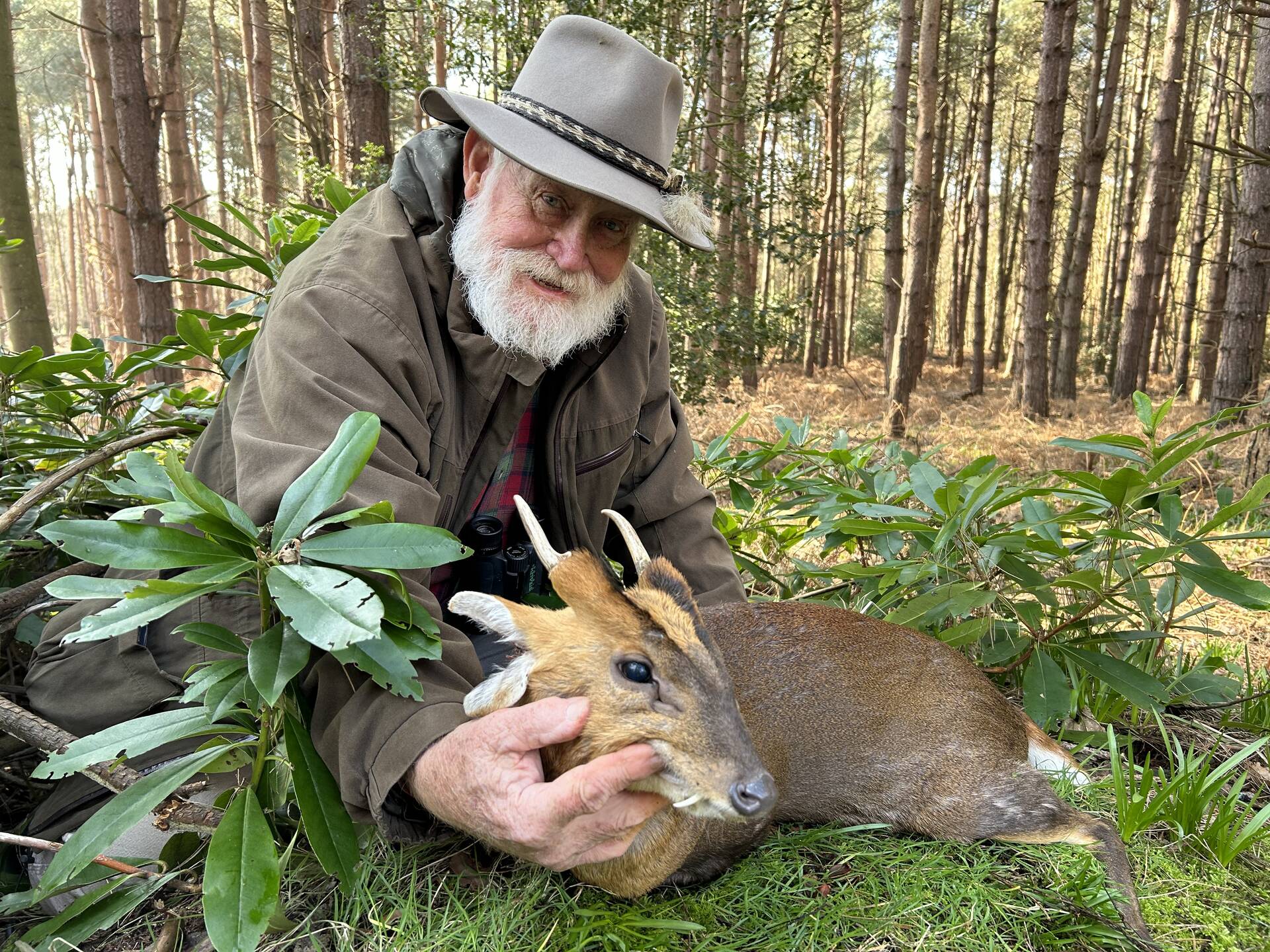
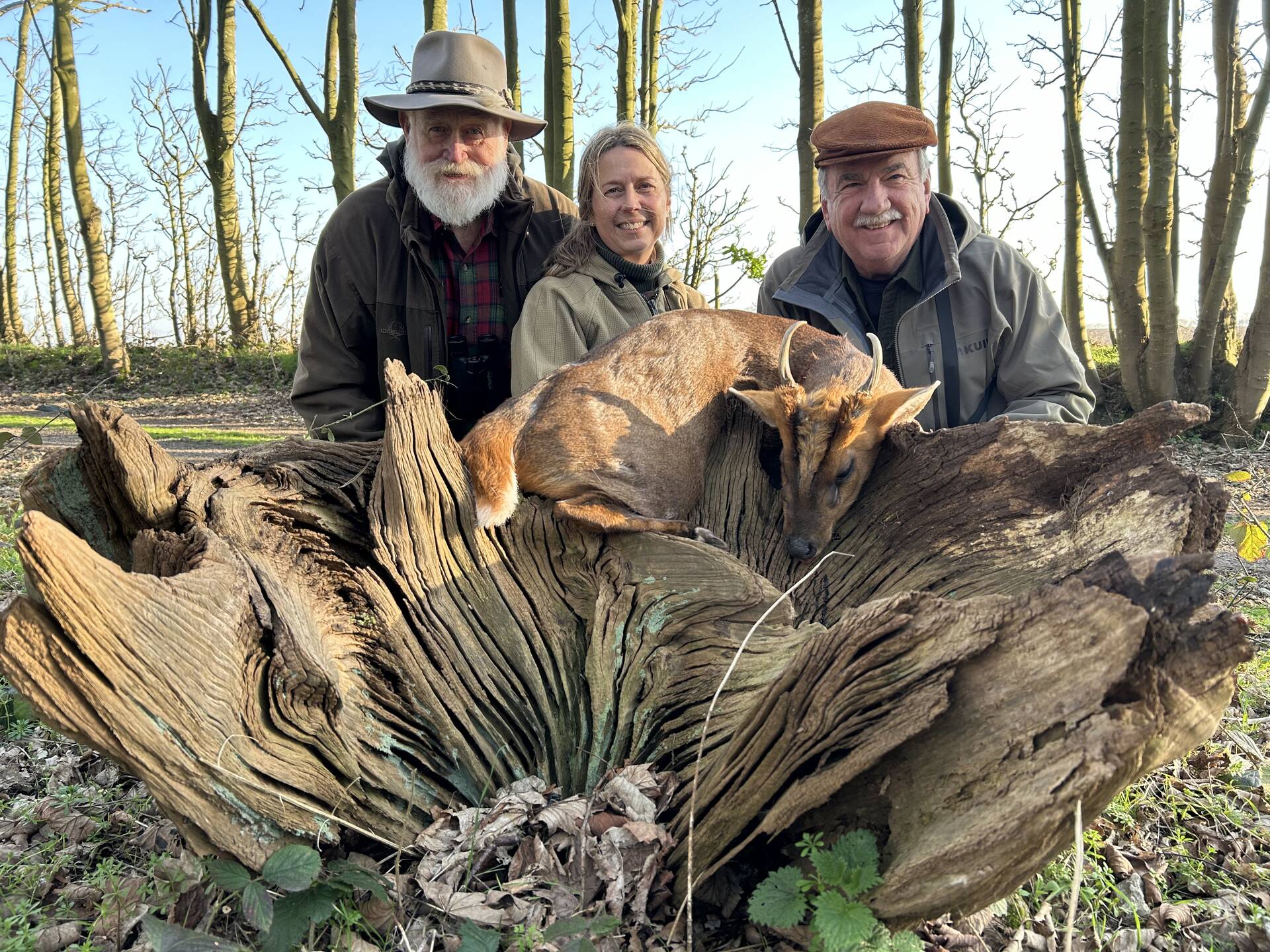
Moments later we were at my buck’s side. I was thrilled beyond words. Not only were his antlers relatively long, the right one had a short brow tine as well. He, too, had a split right ear from the base to the tip from a recent fight. A forty-year-long dream had finally been realised.
After photos, Sofia called James. Said he, “Congratulations! I’ll be there as soon as we photograph John’s stag. After we finish, I’ll leave him in a high seat to look for muntjac, then pick up you and your deer. I’ll then retrieve John’s stag and take both to the larder.”
A few minutes later James arrived. We loaded my muntjac, drove to the larder where it would be caped for a shoulder mount to be done by Double Nickle Taxidermy back in Texas, and the meat properly taken care of.
James retrieved John’s stag. It was a perfect 10x10, one of the most beautiful sets of red stag antlers I had ever seen. The stag taken care of, we went to retrieve John to continue his hunt for muntjac.
A short time later I watched John crawl from his high seat. At the vehicle, he explained he had seen two young bucks. We told him we had just seen a really nice muntjac buck en route to get him. James suggested we return to where the buck had been seen.
We drove toward what in Texas would be a motte of hardwood trees. As we did, I spotted the bedded buck. James drove in a different direction, stopped the vehicle. Then he and John stalked the muntjac buck. A few minutes later we heard a suppressed shot. John was smiling broadly when he returned to the vehicle. Moments later James arrived carrying an excellent buck.
John’s buck’s antlers were very close in length to those of mine, although shaped a little differently. As we were preparing to photograph our bucks, John said, “Let me show you an old surveyor’s trick.” He pulled an American dollar from his pocket. “Our US paper currency is six inches long.” He folded the dollar bill in half lengthwise and held it next to the antlers of our bucks. “Both bucks have antlers over three inches long. I’d say we took exceptional bucks, since reportedly any muntjac with antlers longer than two inches is a really good one.” Knowledge learned and a point well made!
Before heading back to our comfortable base camp at the Waveney House Hotel, we stopped at the estate’s pub to share a pint—nay two—of Guinness with James to honour him and the two exceptional muntjac bucks we had taken.
John’s and my England adventure for “Fanged and Vampire Deer” had essentially come to an end. The next morning over breakfast, I spoke to Sofia and Stefan about the “Three Nation Roe Deer Hunt” I would be doing with them during May 2026, and John about his Norway reindeer hunt he and Bruce Keller would be doing with them later in September.
And yes, of course, we talked about another hunting adventure John and I could do with Scandinavian Prohunters after those hunts were completed. I can hardly wait!