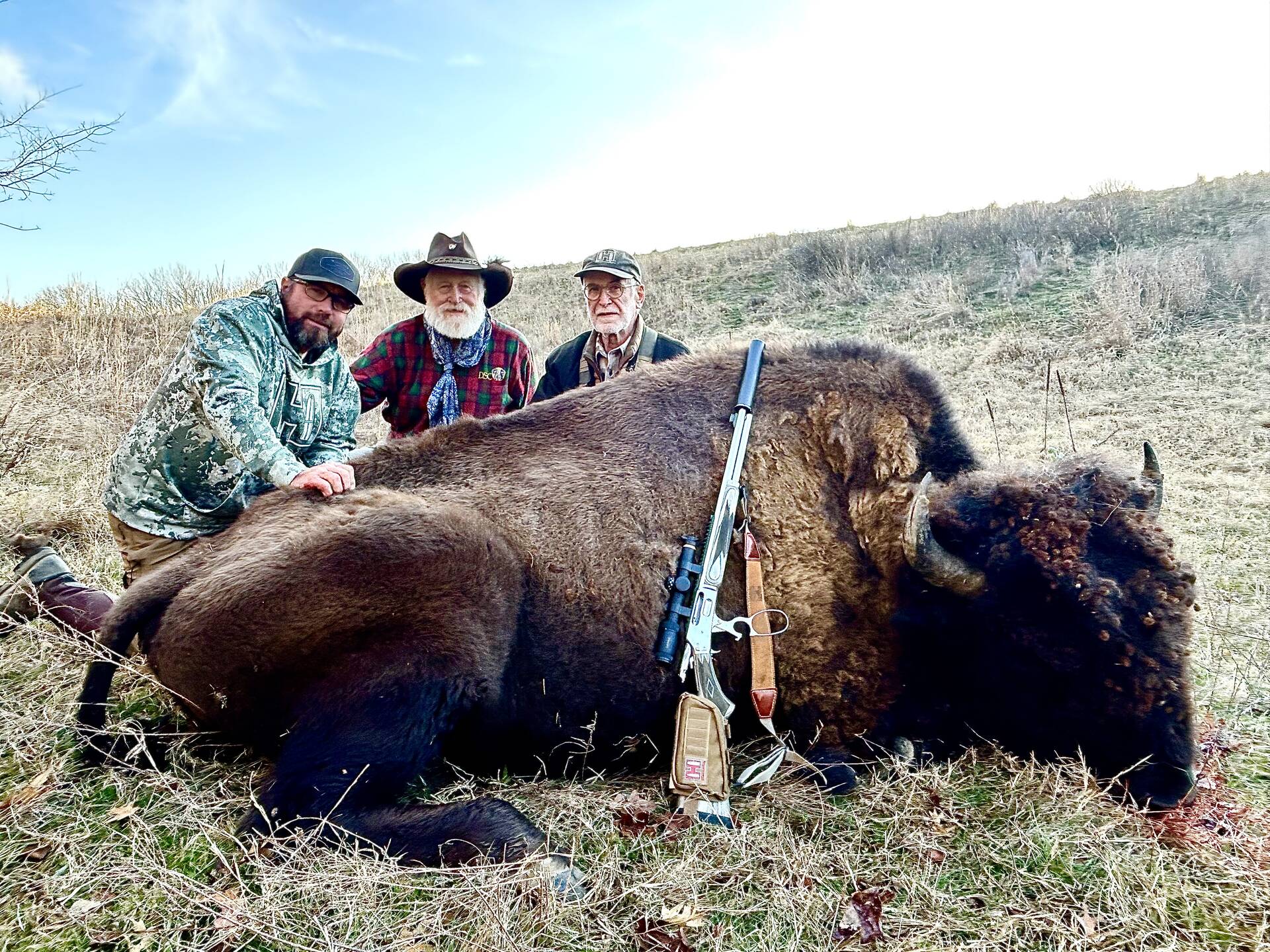
Choctaw Bison a la Steve Hornady
9 min read • 16 March, 2026Some hunts are planned years in advance, while others come together through shared passion and opportunity. In this edition of The Hole Story, Larry Weishuhn recounts a memorable Choctaw McNab adventure with Steve Hornady, a hunt blending tradition, camaraderie and classic big-game pursuit. From careful preparation to decisive field performance with Hornady ammunition, the experience highlights the connection between hunters, heritage and the moments that make a hunt truly unforgettable.
“Was that who I think it was buying our Choctaw McNab?” asked Dusty Vickrey, manager of the Choctaw Hunting Lodge.
“If you think it was Steve Hornady, then you’re right! I talked to him about the hunting and fishing involved in the Choctaw McNab right after I stepped off the stage. He told me he was going to buy the hunt. Let’s go tell him, ‘Thank you’!” I suggested.
“Wow! Steve Hornady is coming to hunt with us!” said Dusty as we headed toward the “Hornady Table” at our 2025 DSC Foundation Gala. Moments later I introduced Dusty to Steve, and immediately it sounded like the two had been friends for years. Plans were made.
Late fall Steve called. “I really want to have a winter cape on the bison I shoot for the mount. Is there any way I could come hunt the buffalo in early January rather than during the spring turkey season when they would be losing their winter coat?” Mr. Hornady made an excellent point.
Dusty and I, because I was to host the hunt, quickly made a decision. If Steve Hornady wanted to hunt buffalo at the Choctaw Hunting Lodge in January, then return during the spring for turkeys and fishing, so it should be. Dates were agreed upon right after the first of the year.
I showed up the day before Steve’s arrival so Dusty and I could scout the estate pasture where the buffalo roamed in hopes of getting an idea where some of the bigger and older bulls were hanging out. The Choctaw Hunting Lodge’s property amounts to about 20,000 acres of free-range and about 2,000 acres of high fence. Their “estate” pasture, comprised of tall hills, low valleys, dense stands of various oak species, persimmons, pine and many green briar thickets, includes a few openings with bluestem grass tall enough to hide even a buffalo bull. On past hunts I was involved with, we had occasionally found the buffalo fairly quickly. On other hunts it took as long as five days.
While Dusty picked Steve Hornady up at a nearby airport, I visited with Mark and Carol Little who had bought an auctioned bison hunt at the 2025 DSC Oklahoma Chapter event. Mark is a past DSC President and currently serves on the DSC Foundation Board of Directors, where I now serve as an advisor to the Board. Carol has chaired and served on many DSC and DSC Foundation key committees. Mark said Carol would be shooting the Choctaw bison. He had taken a huge bull on the Philmont Boy Scout Ranch, a hunt he had bought at auction in support of DSC a few years earlier.
A few minutes later, Carol made certain the .375 H&H Mag she would be using was still properly sighted in. It was!
That evening after Steve arrived, he explained that the rifle he would be shooting, a .45-70 Marlin/Ruger lever-action, was one he had borrowed from a friend right before leaving Nebraska. “I had planned on using a .405 Winchester, but for some reason I just could not make it shoot as accurately as I wanted it to. I tried a couple of other rifles, then called a friend and asked if I could use his .45-70 lever-action. Not quite a traditional buffalo rifle. It’s scoped and has a suppressor, but it is chambered in .45-70 Govt., and it loves our 325-grain FTX LEVERevolution ammo.”
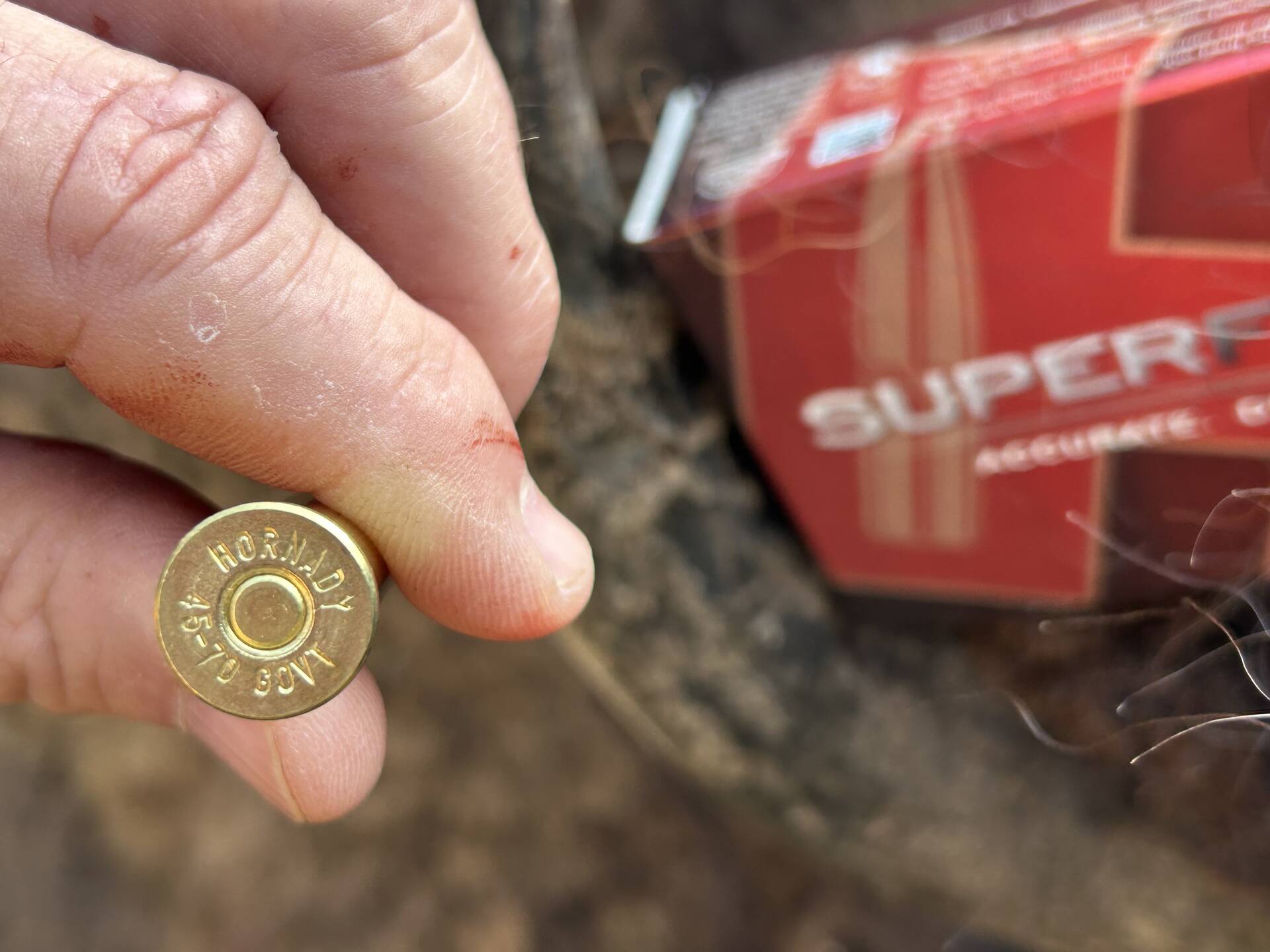
Over a fabulous meal prepared by Nacolh Vickrey, conversation quickly turned to past hunts and hunts we hoped to do in the next couple of years. There was also much talk about the morrow’s bison hunt.
“We’ll start with trying to get a bull for you, Steve. Yesterday, before I picked you up at the airport, Larry and I did some scouting. The bull we’re targeting for you was at the far western edge of the property, hanging with three other bulls near one of the conservation lakes, several miles from camp,” said Dusty. He continued, “No need to get out before first light. We’ll plan on coffee, juice, fruit and breakfast rolls before we leave. Then we’ll plan on returning to camp about 10:30 to 11:00 for brunch.”
“Ms. Carol, once we get Steve’s bull down and taken care of, we’ll go look for the bull we are hoping you’ll be able to take. Both are mature bulls, likely weighing 1,400 pounds or more.” Steve and Carol nodded favorably. “You both are shooting larger caliber rifles, which I appreciate. As you already know, buffalo can be hard to bring down. I would suggest you keep shooting as long as the bull is on his feet. We’ll do our best to get you within one hundred yards or less. When the bull presents a broadside shot or is about to, I’ll set up the shooting sticks and adjust them appropriately. Remember, a buffalo’s heart and lungs are low in their body. Come up no more than one-third from the bottom of the body. Shoot and please keep shooting as long as the bull is on his feet. That said, I feel kind of silly reminding y’all about all this with the hunting experience you have, but it’s something I do with all our bison hunters.”
After coffee, more hunting and gun talk, we loaded into two of the Choctaw’s ATVs and headed toward where Dusty and I hoped we would find the bull we wanted to put Steve on. In doing so we spotted and drove past several whitetails, a small herd of elk, a couple of fallow bucks, and several of the truly unique Choctaw mule-footed hogs.
Rounding a bend in a road so we could see the conservation dam, Dusty, Steve, Jeff Rice (who would film Steve’s hunt for our “A Sportsman’s Life” digital television which airs on carbontv.com) and I spotted four buffalo bulls. They were feeding on the lush grass below the dam. We stopped and backed up out of sight of the bulls.
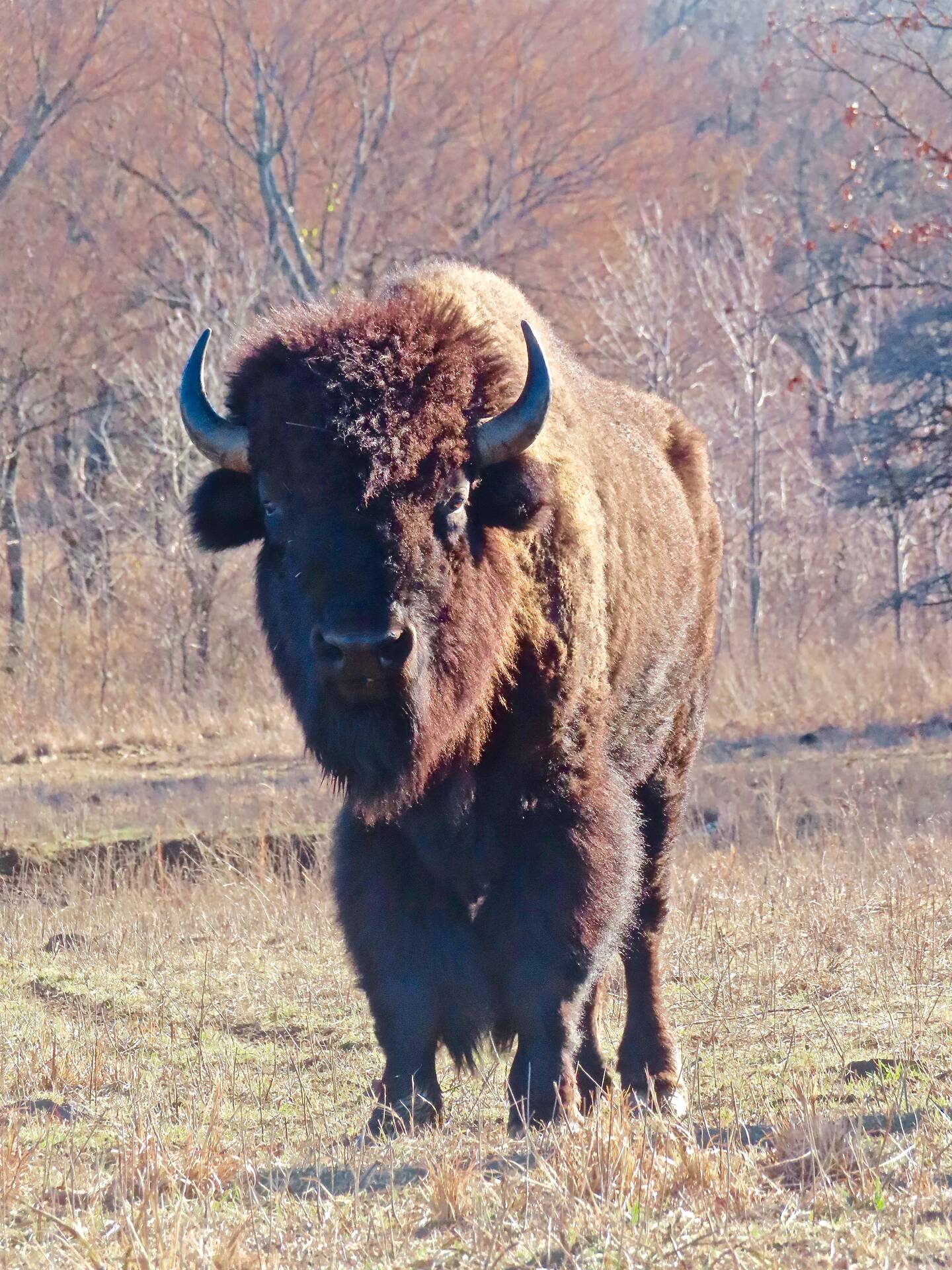
“Wind is in our favor, let’s drop on the water side of the dam where we can’t be seen and head toward where we think the buffalo should be on the opposite side. It looked like they were about 350 yards away,” suggested Dusty. Steve nodded affirmatively and loaded his lever-action. With that, we started walking fully out of sight of the bulls.
A short time later, “Steve, we should be just about across the dam from where the buffalo were when we spotted them, if they have not wandered away. Let’s ease to the top of the dam. I’ll set up the shooting sticks for you. Your bull is bigger and taller than the other three,” said Dusty.
We moved upslope with Dusty and Steve in the lead, Jeff and I following. I too had my camera and would be filming Steve and Dusty while Jeff concentrated on the buffalo.
Thankfully the bulls were still where we had initially seen them, occupied with grazing on lush grass. We were above them forty or so steps away. The bull we were after stood broadside. Dusty set up the shooting sticks. Steve rested his lever-action rifle, cocked the hammer, took careful aim, then pulled the trigger. No sooner had he done so, he levered out the spent case, seated another and shot, then levered in a third round and shot a third time. I suspect had he four rounds in the rifle he would have shot a fourth time. But it would have been for naught; essentially the bull was dead with the first shot. It just took him a bit of time to fall.
Immediately when Steve’s bull fell, the other three bulls started horning the downed bull, typical buffalo behavior. Dusty and I watched the buffalo. Steve loaded more rounds, just in case.
After a while the bulls backed away but stood between us and the downed bull. At that point Dusty waved the vehicles toward Steve’s bull in an effort to chase the three bulls away. It took a bit of encouragement for them to leave, but finally they walked away, then stopped four hundred yards away. Members of the Choctaw staff made certain there was a vehicle between the downed bull and us. That’s when we walked to Steve’s bull.
He was huge of body, even bigger than I thought he might be. Steve graciously accepted our congratulations then started admiring his bison. Jeff continued filming. Once he was happy with the footage he wanted and needed, everyone converged on Steve and his bull.
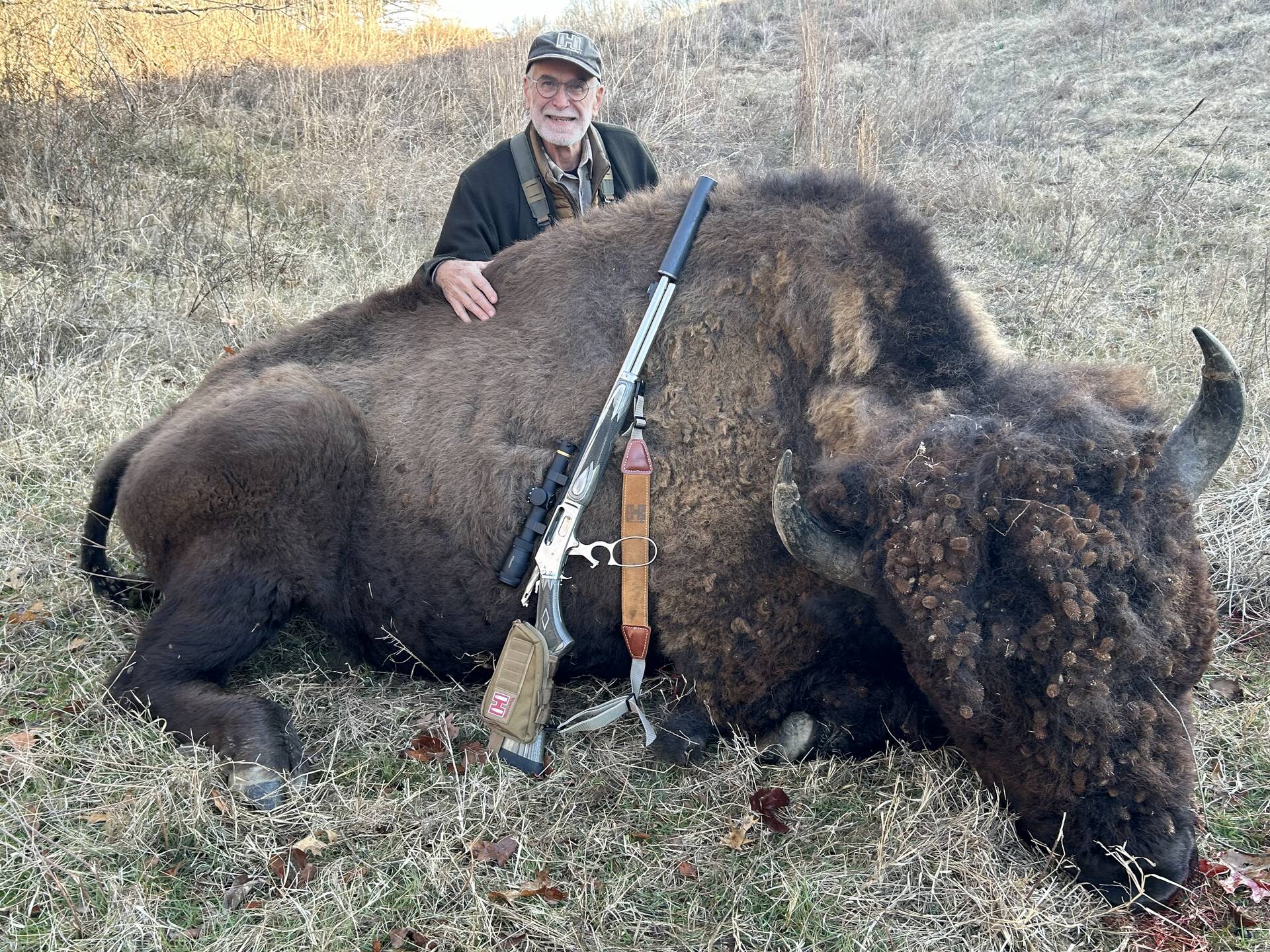
When we had taken the still photos we wanted and needed, Dusty called in his crew. With a large front-end loader tractor they picked the bull up and loaded it onto a trailer to be taken to a nearby processor.
The first step of Steve Hornady’s Choctaw McNab was complete, which was initially set up where in one day he hoped to shoot a buffalo, an eastern wild turkey and catch a fish. We had set the Choctaw McNab up not unlike the Scottish McNab, which was named after a notorious, fictitious poacher whose goal was always to shoot a red stag, a brace of grouse and catch a salmon in a single day on property he did not have permission to hunt or fish. We decided it should be something legal rather than illegal. We now await Mr. Hornady’s return to the Choctaw for his turkey hunt and fish catching. Dusty and I are trying to decide how many hours to give him to accomplish this.
Carol’s buffalo hunt? We’ll discuss it another time.
Before leaving the Choctaw, it was decided the Choctaw Nation, through the Choctaw Hunting Lodge, will again donate a Choctaw McNab to the 2026 DSC Foundation Gala which will be held at the Gaylord Texan in Grapevine, Texas, July 23, 24 and 25, 2026. If you can’t be there to bid in person, you will be able to do so by clicking here.