
“When that first shot goes off, something or someone will die,” explained the good Doctor as I sat in his classroom at the Southern African Wildlife College on the edge of the Kruger Park. “Think as though you are going over the top on the Western Front. Your shot starts a war, its placement decides how long it lasts and who wins.” I have never heard a keeper say that to me before walked-up grouse, a pheasant drive or a stalker on the hill the final moments before a crawl into position. In fact, on previous trips to Africa, no Professional Hunter has ever said that of any plains game species, however big, buffalo are the real deal; they are dangerous and unpredictable. But with that, exciting. This was the allure for me to hunt the mass of horn and muscle that is the mighty Cape buffalo.
My buffalo story starts not in Africa but in good ol’ Texas at the Dallas Safari Club Convention some four years before. I finally had the chance to meet one of my big game heroes, Kevin ‘Doctari’ Robertson. The Doctor, an author to a host of books on hunting African game, had long captured my imagination. His bestseller ‘The Perfect Shot’ is the title for which he is best known. As a qualified veterinarian and a licensed Professional Hunter in Zimbabwe, this book draws on all of his experience, skills and knowledge. It is simply a unique publication. It has meticulous descriptions of biology, ecology, habitat, and trophy evaluation for nearly every game species in Africa. There is a plethora of detailed photos of game animals taken over many years by his wife Catherine. Overlaid onto each photograph is an anatomically correct diagram of its vital organs and skeleton similar to an x-ray. As every animal’s organs are arranged differently, the book brilliantly teaches hunters to identify where their mark should be for the cleanest kill. Thus, “The Perfect Shot”.
I made a point of meeting the Doctor at a book signing at the Dallas Safari Club Convention in 2011. I always knew my journey to Africa was just a matter of time. The Doctor made a prediction at this first meeting that I would fall in love with Africa, her game and scenery and my destiny would be to hunt Cape buffalo.
Later that year, I was lucky enough to experience my first plains game hunt in Namibia. As the Doctor predicted, I fell madly in love. I subsequently visited numerous times to get my fix. Africa is a special place, anyone that has been there will attest to that. The diversity and abundance of game is hard to describe set in landscapes like no other. My journey had started and I was without realizing it orbiting around the idea of hunting a Cape buffalo.
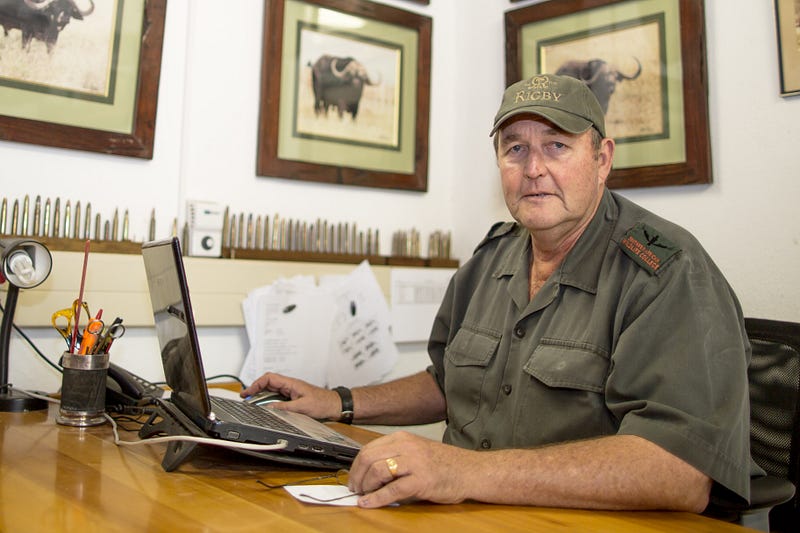
My relationship with the Doctor developed over time. We had started to correspond on email around various hunting and ballistics related topics. One morning, I arrived at my desk to an email from him entitled ‘Buffalo hunt’. The Doctor runs the Sustainable Use and Field Guiding department at the SAWC. The college is dedicated solely to the conservation of Africa’s native wildlife. Its patrons are Worldwide Fund for Nature (WWF) and the Peace Parks Foundation. The SAWC is independently run and funded privately with no support from the South African government. Many of the students that study are not in a position to pay even what it costs to cover the basics for their courses, so donations and fundraising are what keep the lights on. The college is also responsible for training all of the field rangers who keep watch over the dwindling rhino populations in the southern African national parks such as Kruger. These brave men act as the final line of defense against poaching and are at the thick end of the battle to defend one of nature’s most incredible beings.
The buffalo the Doctor prescribed to me was one such fundraising initiative. The buffalo was actually a donation to the college from the nearby Klaserie Private Nature Reserve. The buffalo would be given in exchange for training their anti-poaching field rangers. The Klaserie is one of the largest privately owned nature reserves in South Africa. It covers 60,000 hectares and has no fences thus forming part of the greater Kruger Park. It is run by a committee made up of owners from the 70 farms that make up the reserve. The history of the Klaserie is a good news story for wildlife. In 1969 a number of forward thinking farm owners decided to drop their fences and combine their land to offer a more natural range for some of the migratory and nomadic species. Other farmers followed suit and over the years the unspoilt Klaserie has become one of the most exclusive places to own a property in South Africa — and for good reason.
Although the wildlife is left to manage itself in a natural way, it is fiercely protected by the reserve. Without the anti-poaching effort in the Klaserie, there would be no rhino. Here’s why; for whatever bizarre reason, rhino horn fetches $100,000 per kg. A mature rhino will have a horn of around 3kg in weight. The Greater Kruger and Klaserie borders some of the most impoverished areas in the world where our Western ethics and morals are far less valuable than $300k of hard cash for a couple of night’s work. Even with the massive anti-poaching effort across the entire region, three rhino a day are being lost to poachers in the Greater Kruger. These numbers are obviously unsustainable and the rhino herd is now teetering on the edge of terminal decline.
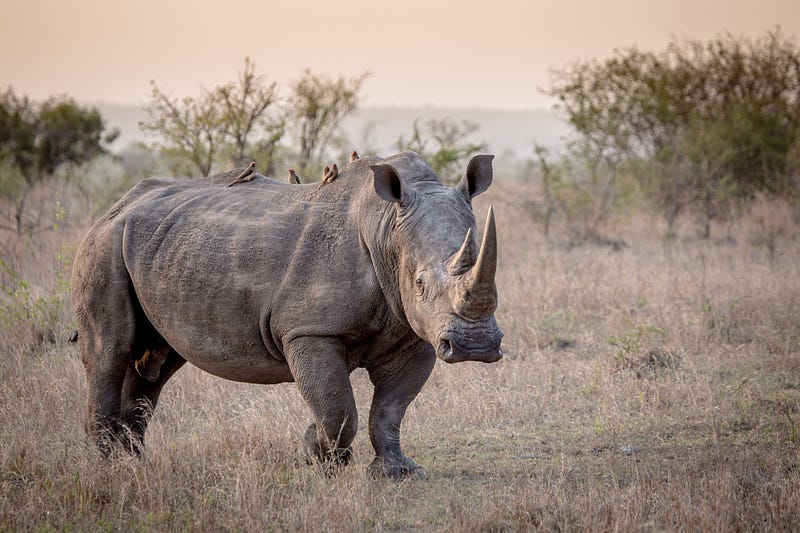
The anti-poaching effort in the Klaserie runs an annual bill into the millions of Rand. New intelligently-alarmed electric fences and the paramilitary force of 26 armed field rangers, their training and equipment does not come cheaply. The Klaserie is 60k hectares. Now extrapolate the anti-poaching costs of 60k hectares across the Kruger Park’s 2m hectares. The cost to protect these animals from almost certain extinction is mind-boggling — and this is just the Greater Kruger not the whole of Africa.
In order to fund the anti-poaching activity, the privately owned Klaserie allows 1.25% of the reserve’s buffalo and 0.5% of the reserve’s elephant population to be hunted annually. It has been scientifically proven many times that removing these minute percentages from a population has no effect on the size and health of the herd. Trophy hunting also focuses on old males usually past breeding age that have no effect on reproduction. A census of animals is compiled every year, last year a population of 2,500 buffalo and 1,200 elephant were counted. The numbers hunted every year is strictly based on percentages as population fluctuates dependent on other variables such as drought or a bumper birthing year. There can be no argument that the income generated by the harvestable surplus of animals from these trophy hunts directly benefits the reserve’s wildlife population.
The Doctor explained all of this to me in his email. Yes this was a trophy hunt, but it was about sustainable utilization. The bull we would hunt would be the oldest buffalo in the Klaserie, the older the better. I knew many buffalo shot in Africa hardly made their eighth birthday, so tracking an animal over 12 and past his breeding prime was my ideal hunt. Also included in the hunt was attendance on a one-to-one buffalo course run over two days at the wildlife college before the hunt.
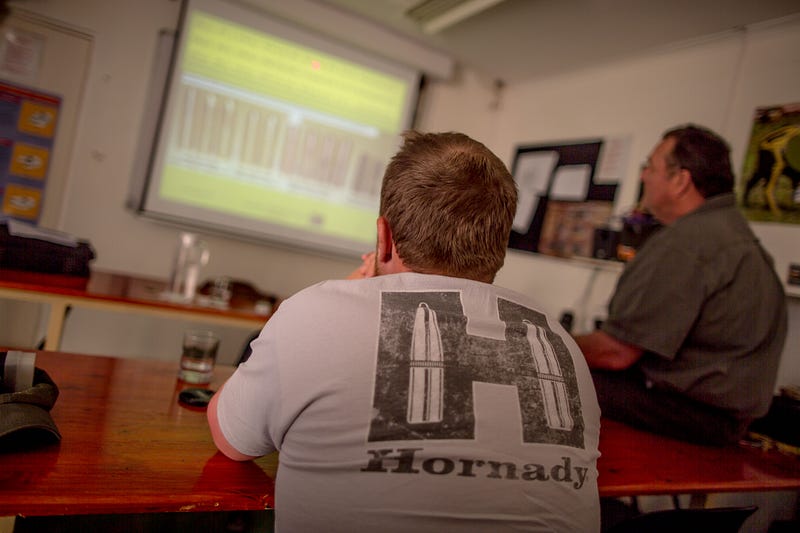
The course was fascinating. I spent a day in the classroom studying thousands of buffalo images to give me a photographic reference on how to judge age, horn size and suitability. We also examined anatomy to the point at which when I closed my eyes I could visualize every muscle group on a buffalo’s shoulder mass and where I must shoot at whichever angle to obtain the perfect shot. It was intense but I loved it. The Doctor has encyclopaedic knowledge on the subject as you might after taking 600 buffalo to his own rifle. The second day was spent on his simulated stalking range where he has created 10 life-sized cut outs of buffalo standing at differing angles. The organs are invisibly marked on the targets and change color when shot so it is possible to identify how good each shot was. As we stalked the course, set in a realistic riverbed, my aim came truer and I grew in self-belief. This unique two-day course meant I could be sure when the moment came, I had a frame of reference to work to and I would confidently get the job done.
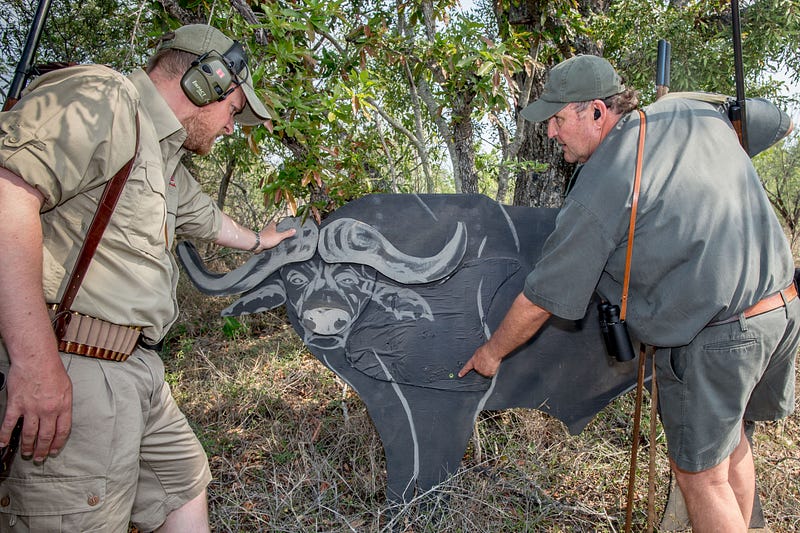
The following morning at dawn we headed to the Klaserie, an hour’s drive from the college. Guiding the hunt was PH John Luyt of Duke Safaris. John has hunted the Klaserie for many years and is a past assistant warden of the reserve. He is now its hunting representative and guides all 30 or so buffalo that are taken every year. I could immediately tell from John’s manner that he was a seasoned PH. Even Eddie our tracker was a licensed PH so the collective experience and knowledge to support me was immense. I could not have been more ready to commence the hunt.
Once we had signed all of the necessary paperwork at the reserve’s headquarters, the first morning’s hunting would take us along the dried Kongongyane riverbed, a tributary of the Klaserie that runs the length of the reserve. This river is one of the reasons the Klaserie is such a perfect habitat for buffalo. As the Doctor had explained in the classroom, the buffalo’s only weaknesses is their need to drink at least once a day.
It was my first time hunting dangerous game and the occasion was not lost on me. Within half an hour of leaving the safe confines of the Land Cruiser, our first dangerous game encounter took place — but not a buffalo. As we stalked the sandy riverbed, we heard a loud spine-tingling snarly growl of a cat, not 30 meters from us. After quick investigation of the tracks, we had just bumped a female leopard — complete with cubs — off a fresh impala kill. The kill was so recent its nerves could still be seen pulsating under the skin of the slumped carcass. It was time to move on. As we promptly left the area, we could hear her spitting angrily in the bush.
Over the next three days with many more incredible wildlife encounters, we stalked along a large portion of the Klaserie river. We had the chance to study many groups of bulls to look for the old dugga boy I had dreamt of. The majority of bulls we had seen were in the seven to ten-year age class. But finally we found a group of four old veterans. One of these warriors was so old, he literally had no horns left and just a ‘scrumcap’ as they are known. This bull was the 69th we had seen and both Kevin and John aged him late in his 13th or 14th year. For a buffalo to reach this age in lion country is remarkable and only happens with wisdom. We continued stalking the riverbed and saw a further group of 11 bulls none of any serious age. I had to go back, my mind was set on the scrumcap. He was a true dugga boy and the most suitable adversary we had seen. It was late in the day and Eddie our tracker set to work identifying his spoor that was highly identifiable in the group due to its impressive size. With swirling wind and 42 degree searing heat around us, the hunt for a specific bull was on. We spent the rest of the day following his tracks and at last light we left to return to camp and pick up the spoor again the next morning. The night could not pass any quicker.
The next day was an agonizing chase of a small cat and very big mouse. He was crafty and realized he was being followed quite early on in the day. I had heard of old bulls backtracking and thought it was myth — until I witnessed it first hand. During one encounter, we had followed his spoor through thick bush onto an open area only to bump him to our flank. There was physically no way for the old bull to do this without backtracking the open area. You don’t get that old being stupid. The rest of the day was frustrating yet incredibly exciting.
After another early start, we were back on the tracks. The spoor showed us that the herd were relaxed in an open formation feeding into the wind. Some way off, along the course they were taking was a waterhole John knew off. The potential for the wind to change when the sun was fully aloft was high so we decided to leap frog ahead of the group and set an ambush along the way to the waterhole. Over the next hour, we moved quickly and quietly around the group using the wind to our advantage. Our ambush position put me in the shade and out of the intense African heat, which had started to get the better of my fair British skin.
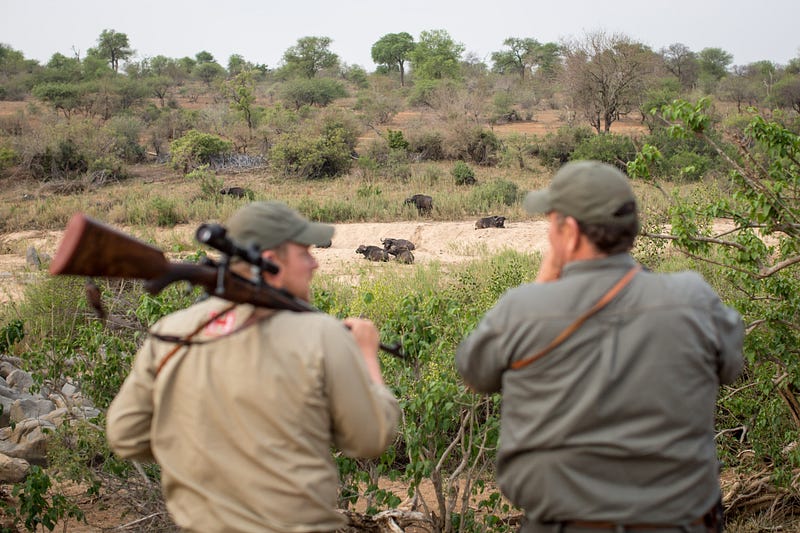
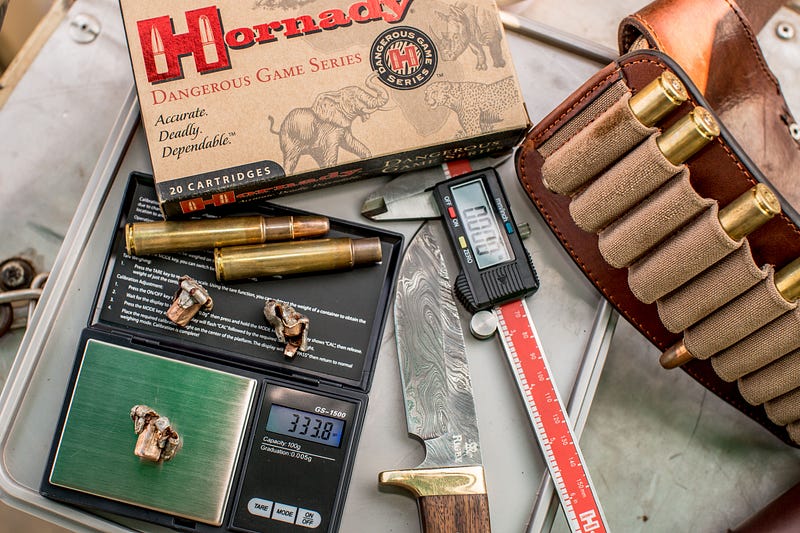
We laid in wait. After an hour then one more, we started to think the crafty old brute had outwitted us once again. But then relief when the first of the group strolled into view. The scrumcap was yet again bringing up the rear. Relief turned to adrenalin like I have never experienced before. What I had learned over the previous week and my many years of hunting came directly into focus. Neither Kevin nor John could help me now. Cometh the hour, cometh the man. A sitting shot on a walking buffalo at 60 meters was before me. I rested my elbows inside my knees offering my 416 Rigby an incredibly stable shooting position save for my pumping heart that was not helping matters. A few deep breaths as the first three buffalo moved across my arc of fire. Then he was there, moving steadily to my front like a super tanker on the high seas. With my Leica scope wound down to x1 power, I mounted the gun and took my moving mark on his hull. Breaching his armor and getting to his vitals with the 400 grain Hornady DGX bullet would be the most important broadside shot of my life. My recent training kicked in and the shot rang out hitting the mark. The bull bunny-hopped forward, a signature reaction to a good engine room shot, and more adrenaline kicked into me as I quickly cycled the bolt. A follow-up shot proved impossible as he ran directly into the herd away from the battle scene.
After half an hour, we followed up some 100 meters to where he lay, two of his compadres stood with him. His head was still up. This was the bit of the hunt I was most nervous about, we were following-up a wounded bull buffalo, even if the first shot was very well placed, it had not yet killed the bull. I knew the next few moments could be extremely dangerous. Mercifully, my training and guidance from Kevin and John meant a couple of follow-up shots concluded the matter cleanly and with no fuss. And there it was — my first ever buffalo lay before me. This was a life-changing hunt, the emotions were extreme and the satisfaction of identifying and hunting a specific animal of this age was immense.

Photo credit: Tweed Media