All I Wanted
8 min read • 09 July, 2026For many hunters, the most memorable trophies aren't always the biggest. During a trip to the Scottish Highlands, Dr. Mike Arnold found himself pursuing a roe buck that would leave a lasting impression, not just because of its exceptional quality, but because of the hunt itself. In this latest edition of The Hole Story, Mike reflects on a challenging stalk, the beauty of Scotland's roe deer and why that remarkable buck was, quite simply, all he wanted.
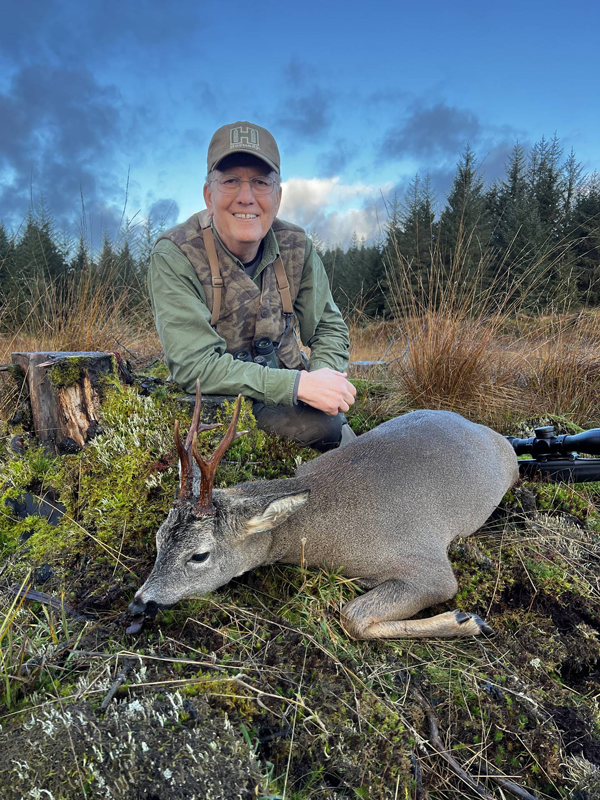
“That is the largest roebuck I’ve ever taken in Scotland.” Martin Reide, my guide, spoke those words as I knelt beside one of the most beautiful trophies I’ve ever taken. The diminutive buck might not have been too impressive to those who prefer going after animals that can turn a human into a snack or toenail ointment, but to me he was magnificent. And, as an aside, if you think Martin’s statement was ‘guide-speak’ intended to puff-up the client, that did not match his Latvian-instilled psyche. In fact, he went on to state, “There are larger ones in Latvia because they have better nutrition, but for the Scottish Highlands, this is a huge, and beautiful, ‘perfect six’ roebuck.
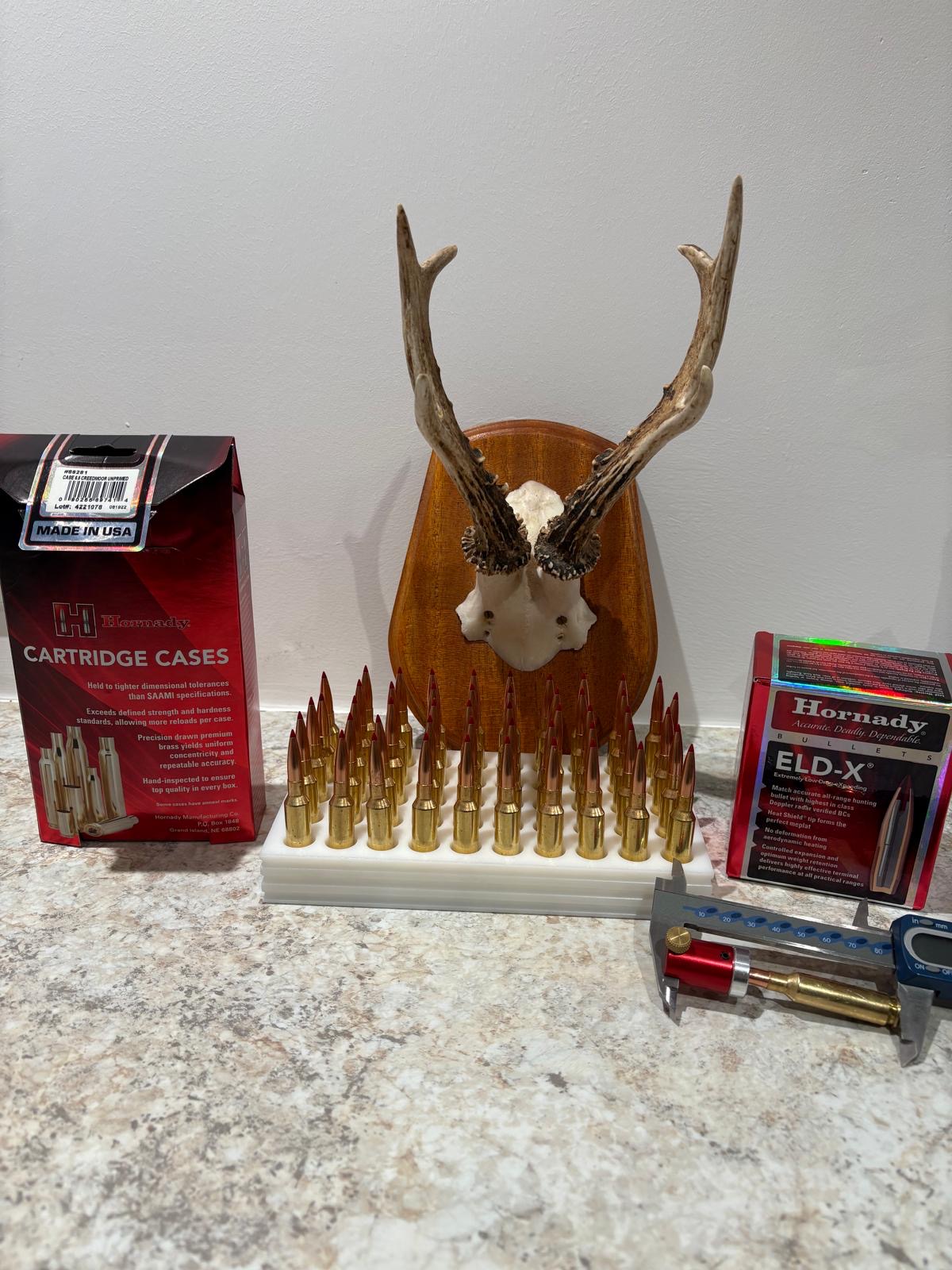
I had no idea how large the antlers on a roebuck in the Scottish Highlands, or Latvia for that matter, could be, and frankly, I did not really care. To paraphrase Robert Ruark when he wrote about a trophy Waterbuck he took in, Tanganyika; this roebuck was all I wanted from that day or that week, for that matter. It wasn’t the size of his antlers, or the number of his points, he was a three-by-three, as much as it was his almost perfect symmetry. In whitetail-scoring lingo, there would be very few deductions for unevenness on the two sides of his rack. But the trophy buck’s beauty did not stop with the lack of significant asymmetry in his antlers. It was also the amazing contrast between his winter pelage coloration and the rich, dark brown of the little buck’s head ornamentation. Likely the antler coloration was a mixture of genetics and the rubbing of the head gear against the Sitka spruce common in the area, with the layers of conifer sap adding to the rich hue.
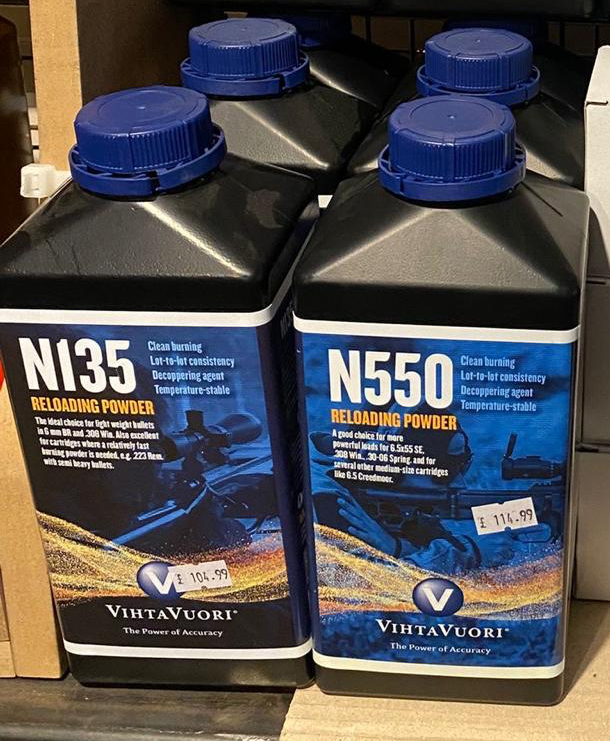
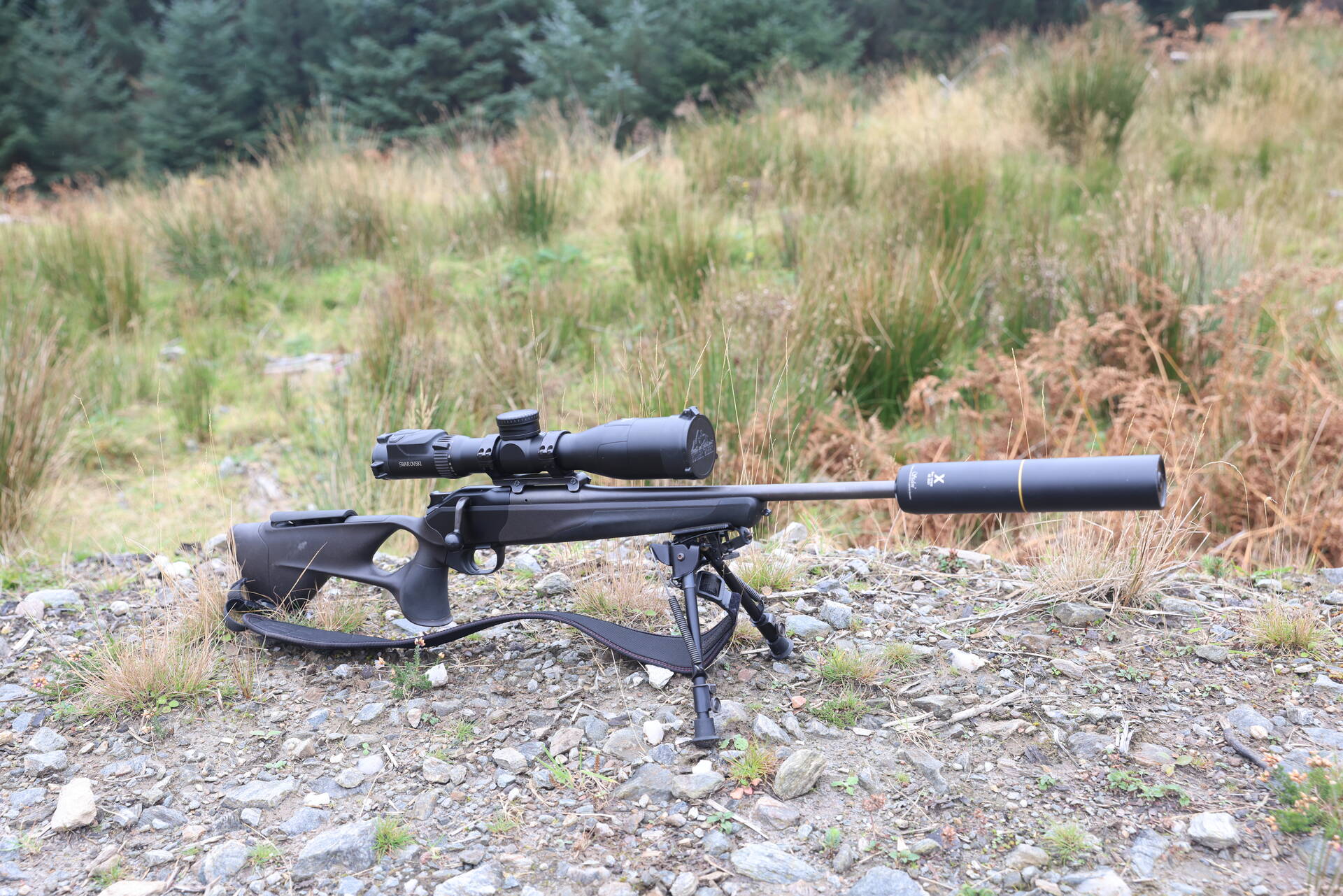
Unusually for me, I did not use my own firearm during my time with Martin. Instead, I used my guide’s recently purchased Blaser R8 chambered in 6.5 Creedmoor. The package included a Swarovski DS, 5x25 riflescope and Stalon X108 suppressor. The cartridges were handloads in Hornady brass, stoked with 36 grains of the Norwegian-Finnish Nammo corporation’s VihtaVuori N550 powder, and topped with Hornady’s 143-grain ELD-X. As some readers may know, I am a believer in the ELD-X bullet design, having used it on everything from leopard to eland to whitetail deer, with no failures recorded. The 143-grain used during my time in the Scottish Highlands accounted for two red stags, a sika, and the roebuck. The only animal that took multiple hits was the sika deer, and only because my first shot was a bit far back. Needless to say, I was again very pleased with the results from this Hornady product.
My hunt for the beautiful little buck lying before me did not actually start out well. I should mention that both Joe Croot, owner of Royal Outfitters UK, along with Martin, warned me that finding roedeer would be a target-of-opportunity situation because, unlike the ever-present red deer, individuals of Capreolus capreolus, were widely-dispersed across the Royal Outfitters’ ~50,000 acres of hunting land. In fact, we’d seen no males, and only a handful of does while searching over the previous three days. On this fourth day of hunting, we headed away from Martin’s truck right at daybreak. We completed our search of the area an hour later. Unfortunately, we saw nothing but red deer, but one of those was a beautiful stag with his harem of hinds. Though he was magnificent, I had two stags and thus wasn’t in the market for another.
As we headed back to the truck and trailer, Martin made a statement that I must admit was not encouraging to me. “It’s probably too late to catch any roedeer in the open feeding, but let’s try by going to the area we finished in yesterday.” A little context will help explain my lack of enthusiasm for Martin’s decision. It wasn’t just his downplaying our chance for seeing these deer at this time of day. The day before had been one marked by torrential rain that led to a near-hypothermic result for yours truly. Having been a hiker and hunter for 50 years, I knew what the symptoms were of a lowered body core temperature. By the end of the day, the uncontrollable shivering and other signs were present. It was my own fault because I wasn’t wearing appropriate clothing for wandering around in a downpour and 40°F. Of course, the game animals were smarter than the two-legged primates and stayed under the cover of the dense Sitka spruce forests; we saw nothing moving. Grudgingly, maybe even with a mild temper-tantrum in tow, I climbed into the passenger seat of my guide’s truck wishing we were heading toward a different destination.
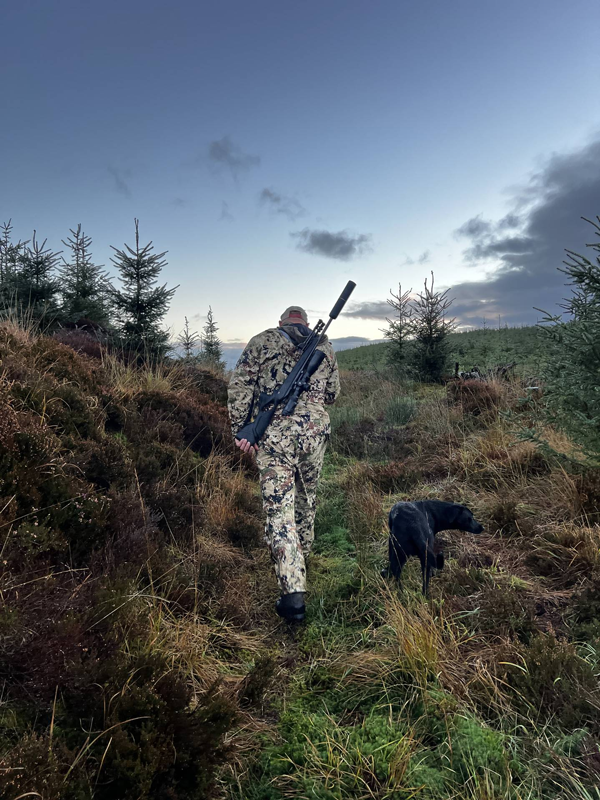
Yesterday’s hunting area was only about 20 minutes from our first stop, and we began our stalking there at 8:30am. Martin and his deer-tracking-sidekick, Bruno, led out. My guide regularly paused and studied the slopes and forest edges with his handheld thermal optic, looking for the heat signatures of game animals. As the morning sun warmed the stumps and downed logs from the harvested stands of Sitka spruce, the optic became impractical, and he and I concentrated on scanning with binocular-rangefinders.
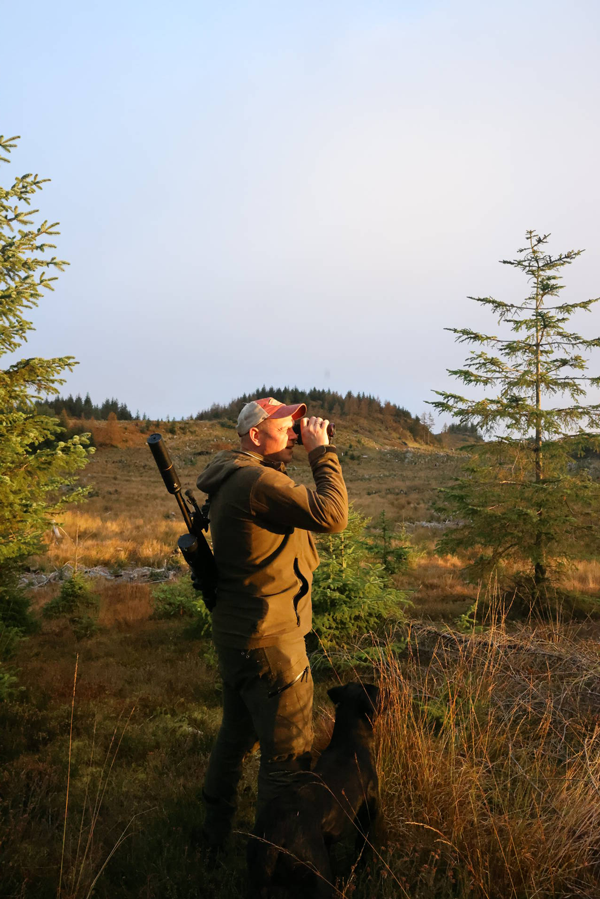
It was during one of our pauses that Martin, with binoculars against his eyes, hissed, “There’s a buck!” Following were those words I most dread to hear from the lips of any guide, “Do you see him?!” I fear this question-demand because…I generally don’t. It was the case this time. Regardless, Martin quickly unfolded the Harris bipod and positioned the rifle pointing at the buck. It turned out that my difficulty in spotting this specific animal was a bit more forgivable. The diminutive animal was lying behind a log with only his tiny head visible. How Martin spotted him is beyond my comprehension. However, as I settled behind the Swarovski riflescope, my guide asked again if I saw the roebuck, this time with marked panic in his voice. I was about to give another reply in the negative when through some miracle, I spotted the buck levitate up from his bed. The crosshairs rested on his onside shoulder for only a second before the trigger broke. With the lack of muzzle rise due to the suppressor, I watched the animal stumble and collapse after a mere 10 yards.
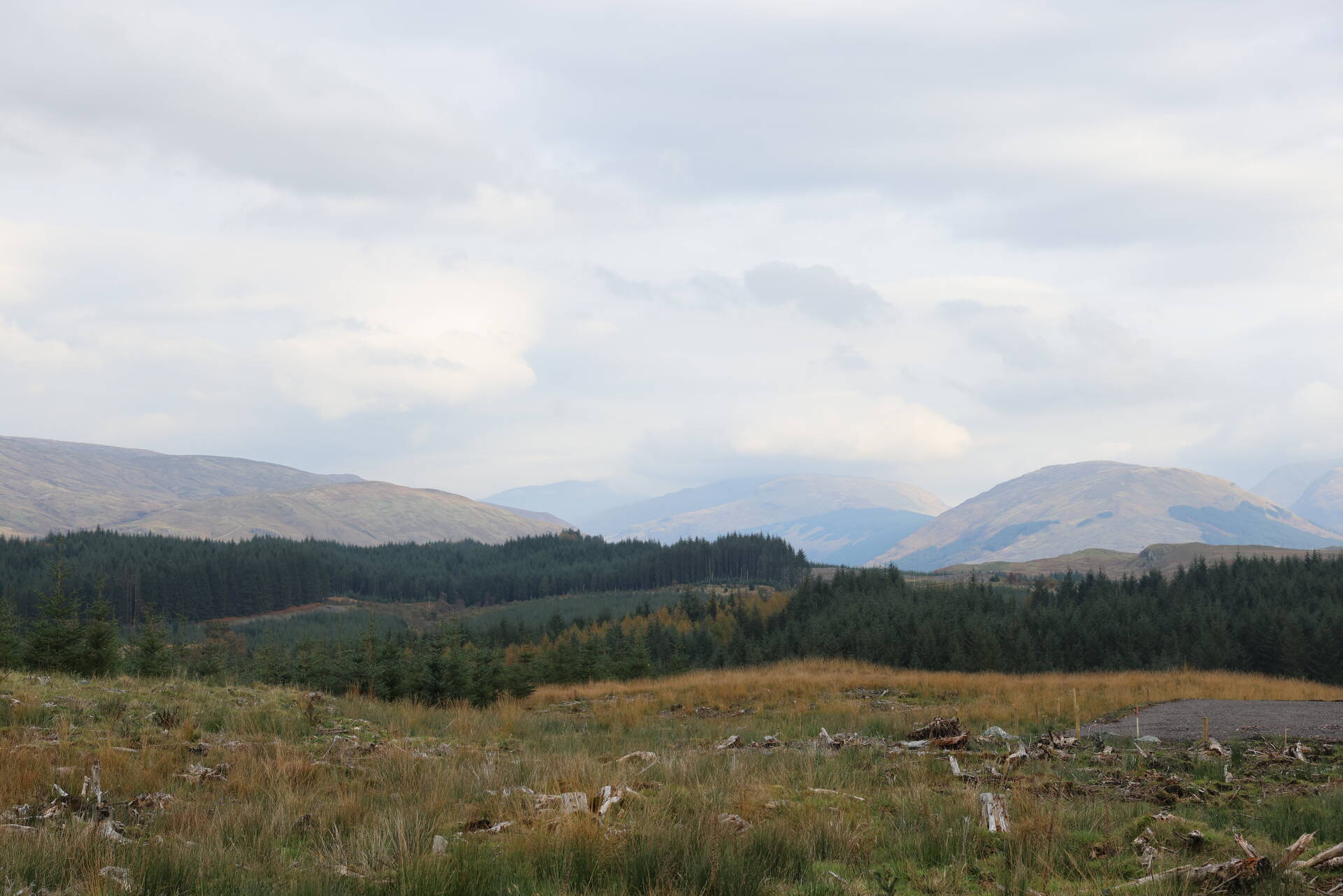
As we made our way across the rough terrain complete with the bogs, tussocks and heather for which the Scottish Highlands are known, Martin asked if I’d seen the buck’s antlers. I answered “nope,” mentioning that I focus on the point of aim when a guide indicates the target animal. His comeback was that he knew it was a mature buck but there had been insufficient time to determine exactly how big he was. As I mentioned earlier, his amazement matched my own when we walked up to the magnificent trophy. Martin was a great guide, always allowing his client sufficient time to savor the victory of taking a prized animal. That was the case here as well. I knelt and stroked the animal’s coat while Bruno stood nearby, seemingly enjoying even more than his hunter the presence of the downed animal.
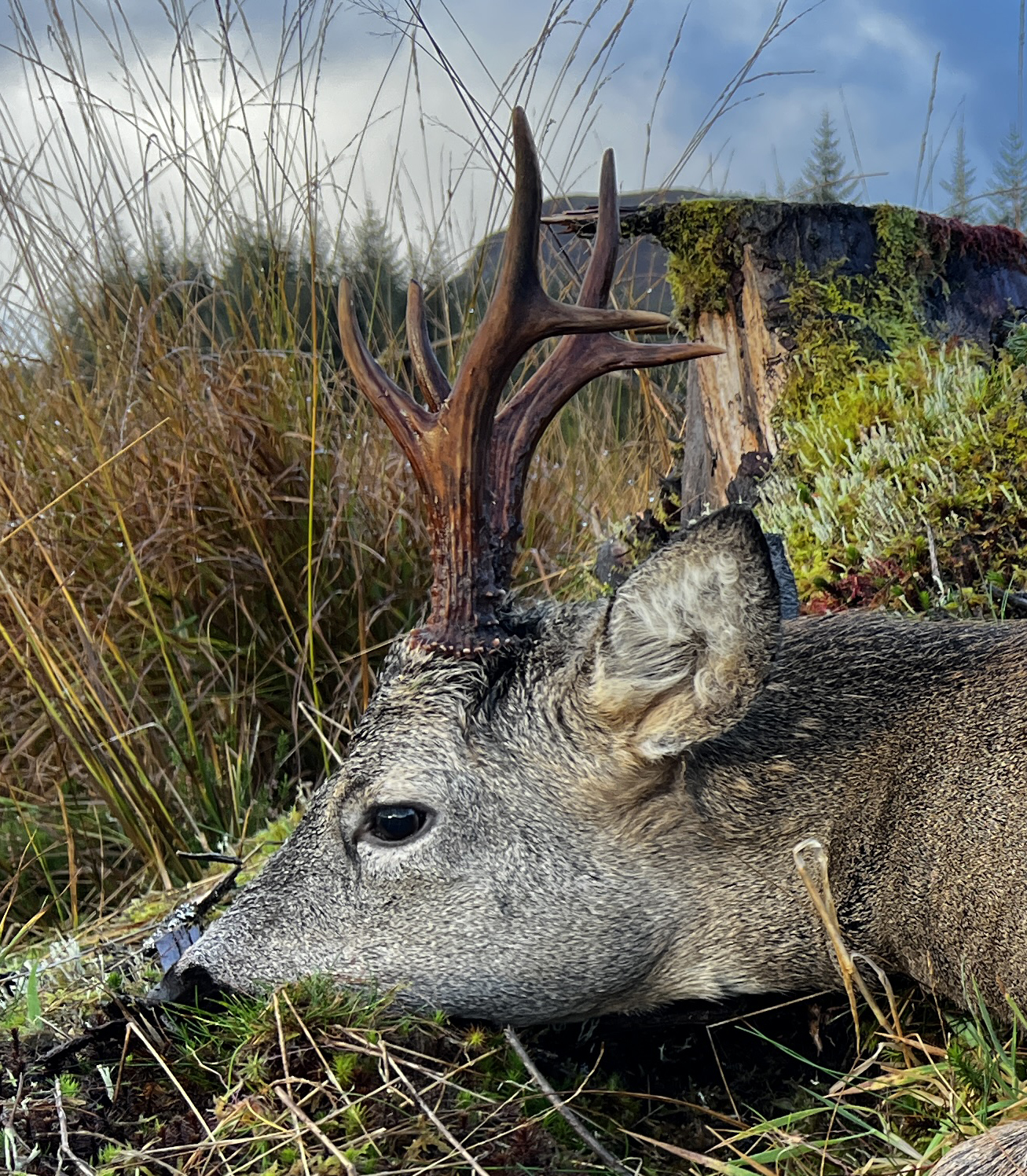
A bittersweetness filled that special moment. I knew that I had captured a memento of another wonderful day in the hunting field. Yet, I also recognized that I had ended a creature’s life. As the moment came to an end, and I rose from my crouch, my guide stepped forward, gently lifting the buck into a position for photographs. As we carefully positioned hunter and prey, I took the time to examine again the beauty of the Scottish Highlands; they were stunning. I believed that I would return to this land, but if not, this roebuck was all I wanted from that day or that week, for that matter.
Author profile
Mike Arnold is professor and Head of the Department of Genetics at the University of Georgia and author of the 2022 book, BRINGING BACK THE LIONS: International Hunters, Local Tribespeople, and the Miraculous Rescue of a Doomed Ecosystem in Mozambique. Mike’s newest book, BRINGING BACK THE WILD – Stories from Revitalized Ecosystems Around the World and How Sport Hunting Supports Them, appeared in June 2025. You can find a description of Mike’s travels, talks, articles, and books at mikearnoldoutdoors.com.