The visit had been a good one, much talk of desert mule deer, whitetail deer and management of populations and habitat. I was in Fort Stockton, Texas to present an after-dinner talk to the local Mule Deer Foundation Chapter’s annual gathering. I listened intently to John Eason explaining the procedures and results on the Eason family’s property just west of Pecos River. John told me bucks, of both species, harvested on their property averaged 180-pounds. He then asked what I, as a wildlife biologist, would suggest doing regarding their management program. Without hesitation I responded, “Do not change a single thing! If you’re regularly producing deer like that, simply keep doing what you’re doing!” John smiled.
Fast forward several years. “When are you coming hunting with us?” asked John Eason. A week later Luke Clayton, Jeff Rice and I were headed to the Eason Ranch, for Luke and me to hunt mule deer for our “A Sportsman’s Life” weekly digital tv show, now on CarbonTV.com. During the hunt Luke shot a nice buck. I passed some young bucks. While there, John and I visited and agreed to set up a pronghorn hunt on their New Mexico property, which was to be sold at the 2021 DSC Foundation Gala/Fundraiser. I recently wrote about that hunt where Doug Dutschmann took his first pronghorn.
While on the Eason Ranch with Luke, I made arrangements to hunt both desert mule deer and whitetails during November 2021.
Mule deer have fascinated me since I was in short britches, especially those of the desert subspecies which live in harsh, arid, what some might call wastelands, but the terrain and vegetation I consider beautiful and alluring.
At one of our DSC Foundation Board of Directors meetings, where I serve alongside Dave Fulson, a primary in Safari Classics, which among other tv shows produces “Trijicon’s World of Sports Afield”, I told Dave about my upcoming Eason Ranch hunt. “How about we send Jeremiah Bennett to film that hunt? Sounds like it could be interesting, especially if you can take both a desert mule deer and whitetail on the same hunt.” Before leaving Dallas, plans were chiseled in stone and set in motion.
Prior to heading to the Eason Ranch, Jeremiah and I spent several days hunting with Nomad Hunts. During that hunt I rattled in several whitetail bucks, and I passed several nice bucks. I was there to try to hunt one of two bucks, a huge typical 10-point and the other a massive non-typical. The 21,000-acre low-fence ranch near Ozona provided great adventures, but the two bucks I hunted eluded me — more on that hunt in the future!
Jeremiah and I left our hunt near Ozona and headed west to Iraan to hunt the Eason Ranch, which is most interesting in terms of desert terrain and vegetation, as well as pre-European arrival history, not to mention both whitetails and mule deer.
The first evening in camp we saw but one distant whitetail, and lots of tracks. That night as I was cooking supper, John and his brother Jeff showed us recent trail camera photos of bucks. There were several great young bucks, as a couple of older bucks, both mule deer and whitetails. The older bucks would fit my bill to a ‘T’. I was looking first for mature bucks, both whitetails and mule deer, secondly for nice antlers. Desert mule deer in the immediate do not regularly produce huge racks, but such bucks do exist on the Eason Ranch. This does not make them any less interesting or less fun to hunt.
Jeremiah and I hunted from raised platforms and on the ground primarily, finding places where we saw lots of tracks. We spent much time morning, noon and evening glassing.
A couple of long days into the hunt we set up where we could overlook an expansive valley which led to water. Up to that point we had not yet seen a mule deer. Unusual because of the sizeable population on the ranch.
The sun had been up about an hour when I spotted movement on the opposite ridge top. Through my 10x Meopta binos I could see it was a buck; antlers with decent tine length, and nine total points, with main beams that spread about ear wide. He was deep through the chest, and obviously mature.
While Jeremiah filmed, I adjusted my shooting sticks, cranked up my Trijicon scope’s magnification and followed the buck as he appeared and disappeared in dense desert thorn brush. “I’m on him. He’s out about 200. Take him when he clears the next bush,” whispered my cameraman. Words I longed to hear!
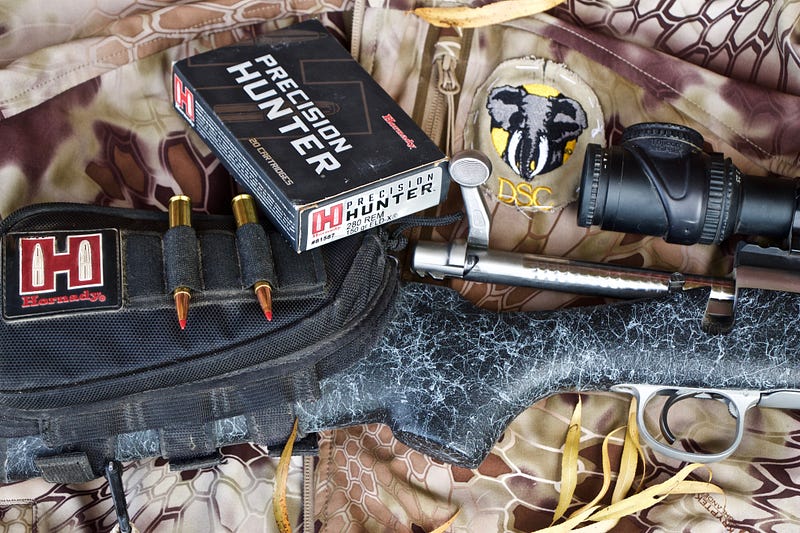
I pushed from safe to fire, my Model 700 Remington Mountain Rifle chambered in 280 Rem, shooting Hornady 150gr ELD-X Precision Hunter. I let out all my breath and then started squeezing the 2.5lb Timney trigger. I watched as the bullet struck a limb about two-inches above the buck’s back. He turned to run where he had come from, but then stopped. By then I had bolted in a fresh round and again held for a shoulder shot. Again the bullet passed just above the buck’s back, this time striking a rock. The buck ran. I bolted in another round got on target, held for the appropriate lead, and again watched as my bullet again struck high, just above the back. Before I could send a fourth shot in his direction, he was gone.

Hornady 150gr ELD-X Precision Hunter in 280 Rem
All three shots had gone just above the unscathed buck’s back. I could hardly believe it. Earlier at the range I had put two shots essentially into the same hole at 100-yards. Later that morning, again back at the range, my bullet struck the target exactly where it was supposed to.
Explanation? I simply missed! Obviously, it had been “bullet sender’s error”. Back at camp I confirmed zero, right where it was supposed to be.
Oh well, you live and learn.
We hunted hard for the next several days, and saw very few mule deer. It seemed they had crawled into a hole and pulled the rocks over the top of them. “I have never seen anything like this!” proclaimed both Jeff and John Eason, “I wanted you to come in to hunt early November, while we were still able to pattern them, based on trail camera photos.” The Eason Ranch (432–836–4527) is permitted to start hunting mule deer early thanks to the Texas’ Managed Land Deer Permit system. Hunts, even with rifles on such properties begin with the fall archery season and run through to the end of January. The number of bucks and does allowed to be harvested on the permitted property, during the extended season, depends on the total and adult population, fawn survival rates, buck to doe ratios, habitat conditions and long-term objectives and goals.
Unfortunately, the mule deer and the whitetails had apparently read our script. It came down to the last afternoon of the hunt, although we could hunt until noon the following morning. After a long discussion Jeremiah and John decided we should set up on an open platform, overlooking the confluence of three different canyons. It was here a couple of days earlier we had seen a narrow antlered buck, that looked mature, but were never given a clear shot. Hopefully that one or another would put in an appearance.
In the early afternoon, we spotted a distant spike mule deer buck, a youngster forkhorn mule deer buck, and a pretty darn good whitetail. Light was fading quickly when I spotted a narrow, although mature mule deer buck walking downslope towards us. “I’m on him!” said Jeremiah. Because of where he was, I switched to shoot left-handed. Although originally a right-hand shooter, I long ago taught myself to shoot left-handed as well. I pulled the trigger on the deer and watched in awe, as the bullet struck a rock immediately above his shoulders. He ran, I shot a second time and again hit right above his now fast-moving shoulders. I bolted in a third round followed the buck through the scope, but this time held lower than I had been doing, at the about to depart 200-yard distant buck.
I saw the buck stagger, as if he was hit through both hindquarters. Before I could shoot again, he was gone. “You hit him” said Jeremiah. “He staggered.” He quickly checked the footage. Indeed, I had hit him on my last shot. “I don’t think he’ll go far!” I hoped and prayed Jeremiah was right. I loaded more Hornady loads into the magazine.
“I’ll go look for blood. Direct me to where we last saw him.” I suggested to Jeremiah, knowing once I dropped into the canyon and started up the other side, things would look totally different.
Jeremiah waved me farther to my left. I started circling, but could not find any blood. A few minutes later Jeremiah was walking towards me. “I looked closer, you hit him pretty good. He’s got to be around here close by.”
I took three steps towards Jeremiah and there spotted a broad blood trail. “There’s blood all over” said I, pointing at my feet. We started trailing and walked 25 steps, but it was getting late and we were quickly losing light. We heard my buck jump and run. We backed out and decided to wait until first light to finish the tracking job.
A cold front had blown through and dropped the temperature nearly 30-degrees. The meat would be fine. Too, there are virtually no coyotes in the immediate area where we hunted, thanks to area sheep and goat growers. I knew if we left my deer out all night he would not spoil, nor would he be eaten by predators.
We met John at the appointed picking up spot and there related my story. John agreed, it would be best to wait until we had the morrow’s tracking light.
The night was an anxious and restless one. My 5am alarm came none too soon. We were back where we had heard my buck bolt before it light enough to really follow a blood trail. We retreated into a blind canyon for better light and to avoid the area where we suspected my buck might be, and to get out of the persistent 20mph chilling north wind.
When we had sufficient light we picked up the blood trail, mostly dark, but also substantial. We followed the trail for another 50 yards. I decided to zig-zag in the direction I suspected he had headed. I soon spotted my buck laying under a cedar bush. I moved towards him, rifle at ready. Mere feet away from him, it became apparent he was dead. At the buck’s side I offered many prayers of thanks.
I could not have been more thrilled. The buck was at least five years of age. He had narrow, fairly massive antlers, three points on one side and four on the other, including brow-tines. He was truly a handsome buck.
Another time I will tell you about my whitetail hunt!
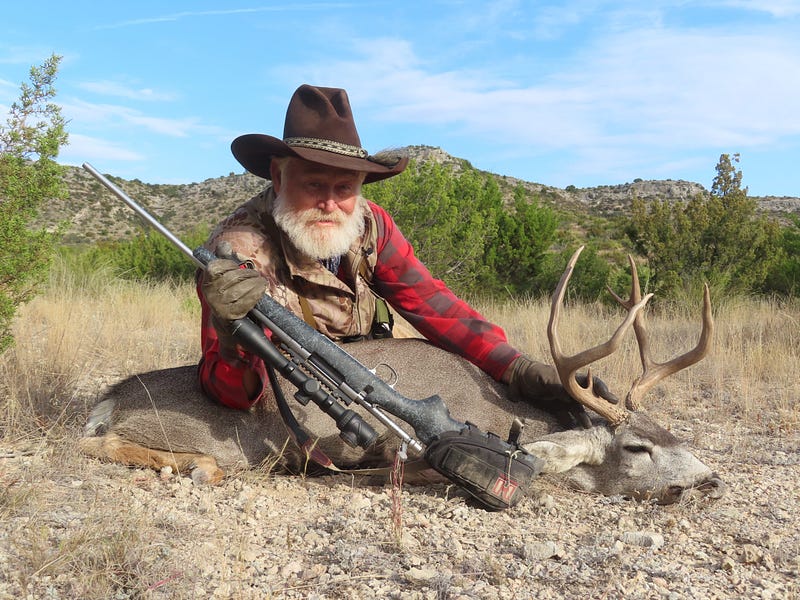
Photo credit: Larry Weishuhn Outdoors