“I’ve got one hunt left unsold in March, are you interested?” Before I could answer the question, Greg Simons added, “Richard Berry will be camp cook and Charlie Buchen your guide!” I suspect Greg, already knew my answer before he made the call.
Greg and I go way back, to not long after he graduated from Texas A&M University. We’ve been on many hunts together and for a period, Greg served as President of the Texas Wildlife Association, which I help co-found many years ago. Today, Greg owns Wildlife Systems, one of the premier hunting companies in Texas.
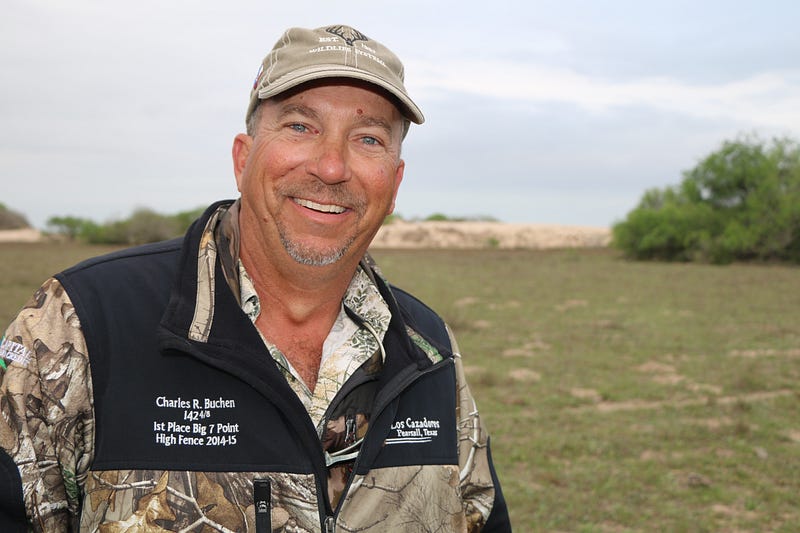
Richard Berry, I regard as one of the finest camp cooks and Charlie Buchen an excellent hunter. So when Greg mentioned those two, I knew the food would be beyond delicious and the hunt a successful one.
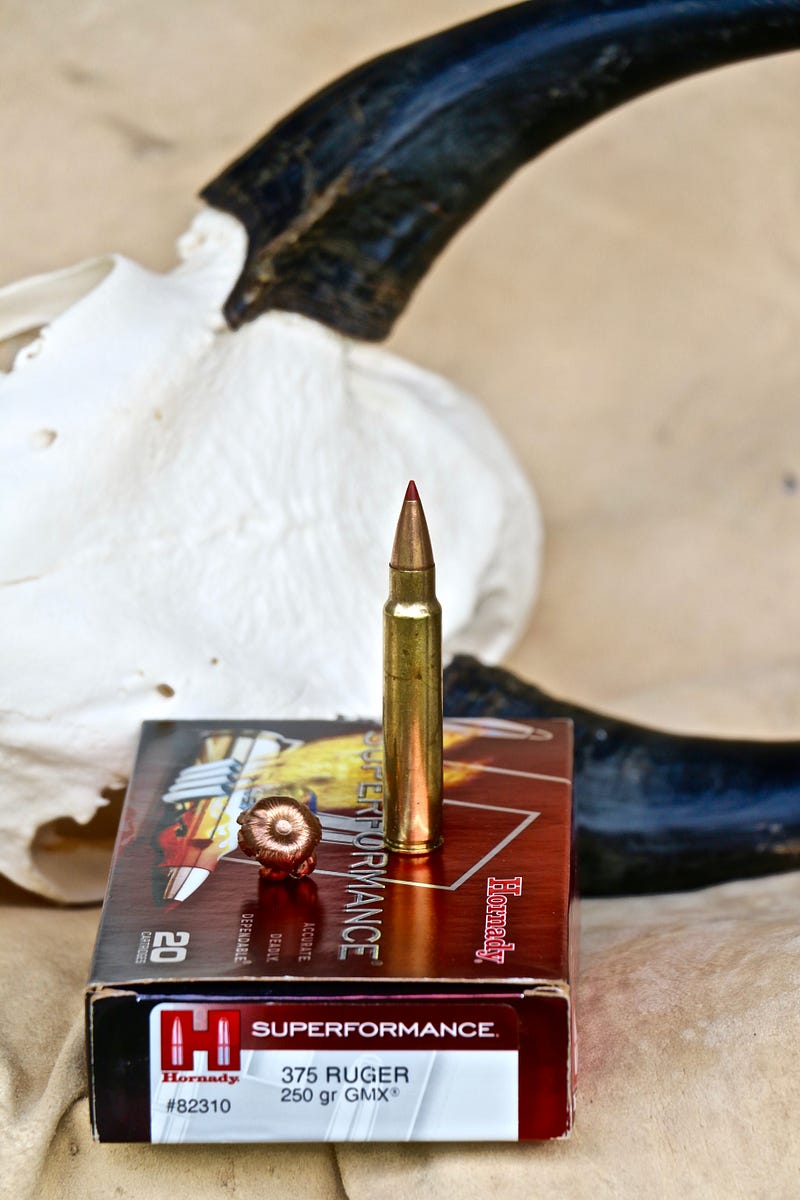
“I’ll email you the address of Port Mansfield house, our base camp. Bring your .375 Ruger and don’t forget your Hornady ammo. As you’re aware nilgai can be extremely tough to bring down.” I knew Greg was right because I had hunted nilgai with Wildlife Systems before.
I politely reminded Greg that we would be filming the hunt for my ‘DSC’s Trailing the Hunter’s Moon’ television show and bringing Al Shacklett, one of our talented cameraman. “Sounds great!” was his response.
Arriving at base camp…
When we arrived at camp, we had a quick opportunity to say “Howdy” to all the hunting party. After stowing our gear, signing the paperwork and a quick clothes change, we headed out to the local rifle range to make certain our rifles were properly sighted-in.
On the way to the nilgai hunting area, I noted Charlie had a back-up rifle, a .416 Rigby. It transpired it was the same single shot rifle I used to take a nilgai with Wildlife Systems, a few years earlier. The caliber I was very fond of, as I’d used one to shoot my first Cape buffalo.
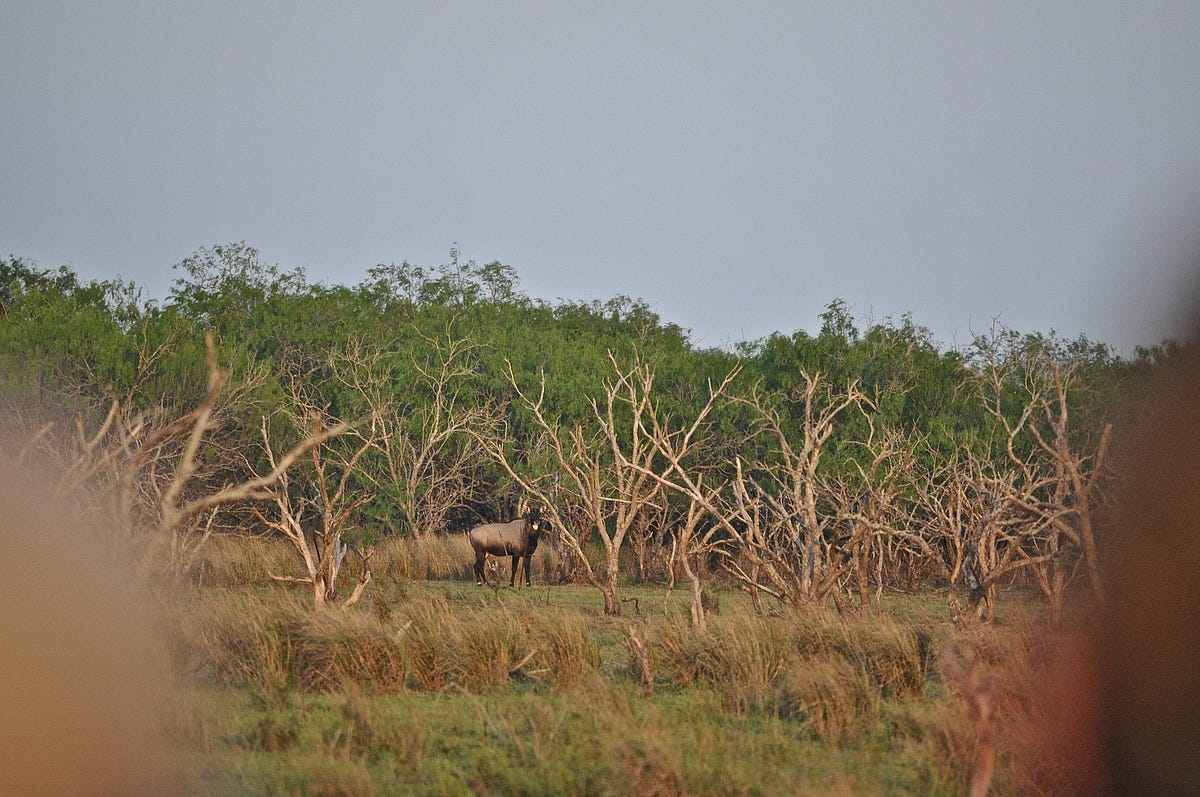
As soon as we reached the ranch, we started seeing nilgai. Our first bull was one with broken horns, who wore a radio collar. The collar was part of the ongoing nilgai research project, to track the movement of individual bulls on the vast East Foundation Ranch. The ranch has become a wildlife research area, not only for nilgai but also oscelots.
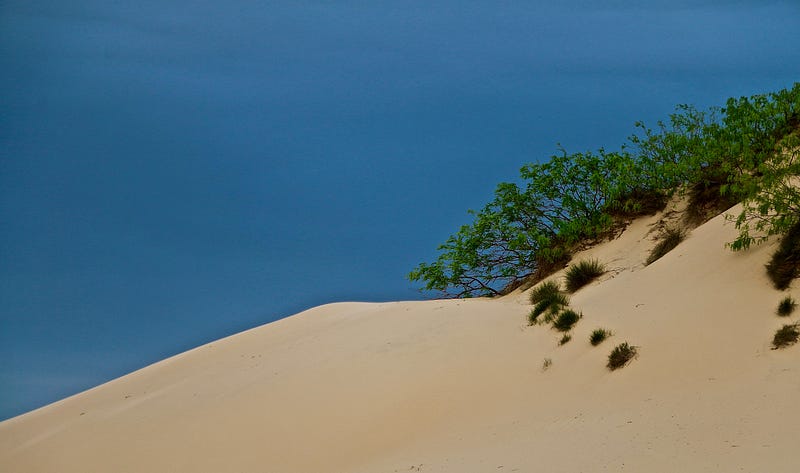
The property we hunted on lies just north of Port Mansfield and west of the Laguna Madre. The terrain and habitat varies from stabilized to unstable sand dunes, tall grasses and sedges, with mesquite and other thorn bushes on the ground, making it the ideal nilgai habitat.
Nilgai were introduced to the region in the early 1900s. Depending on who you ask, they were either accidently released by a traveling circus or were bought from a circus by King Ranch personnel and released to reproduce and provide meat for the Ranch’s vaqueros. Regardless of how they got here, they’ve done well. However they don’t deal well with cold weather, so are pretty restricted to the areas below Corpus Christi.
Today in their native homeland of India there are very few remaining and are often referred to as the “Sacred Blue Bulls of India”.
The hunt begins…
On our first afternoon hunting, we crawled high atop a sand dune, used as our vantage point to glass in all directions. We immediately spotted a group of nilgai, which included three mature bulls. Charlie commented, “That bull is still with a cow and will likely stay with her, the breeding season is almost over but by the way he’s acting, the cow still hasn’t been settled, so he’ll go wherever she goes.” Assessing the terrain Charlie said, “Problem is, there’s no way of getting close to the pair. Of the other two, one is where we’ll spook the cows if we stalk him and the other, on the far right, it’s unlikely that we’ll get close enough to take a shot.”
I was glad Charlie added “close enough”. To me hunting is all about getting as close as possible, before pulling the trigger. I’ve spent considerable time on the FTW Ranch S.A.A.M. ranges, shooting my .375 Ruger, with Hornady 250gr GMX ammo, sometimes at ranges out to 800 yards, shooting metal gongs.
When we started the stalk the nilgai were about 700 yards away. A short time later we had cut the distance to about 500 yards. I knew from my practice at the S.A.A.M. ranges I could if I wanted, put my shot within a six-inch circle, the size of a nilgai’s heart. But pulling the trigger from that distance would simply have been shooting and not hunting.
Charlie, Al and I kept moving forward, utilizing every bit of cover, including the gradient, brush and tall grass.
When we got within 200 yards, we hid behind a small motte of mesquites. Behind the motte, Charlie and I slowed down, carefully trying to peak around each limb to determine where exactly the bull fed and ascertain a clear picture of him before he saw us.
Charlie dropped to his knees and painstakingly slow, moved forward with me following immediately behind. Suddenly Charlie stopped and pointed, indicating he’d spotted the bull through the brush, so slowly I moved forward into place. The bull was feeding and unaware of our presence, with less than 60 yards between us. He was a mature bull, dark in color, with two nine inch horns present and his neck still swollen from the rut.
Keeping an eye on the bull, Charlie inched forward, set up my shooting sticks, then I slid into position, rested my Ruger FTW/SAAM Hunter on the sticks and pushed the safety forward, to the second of its three stages.
Through my Trijicon scope I noticed there was a branch in the way, immediately in front of the barrel, just as I cleared the rifle from the branch, the bull looked back in our direction and within a split-second he vanished. I looked back at Charlie, who started smiling.
“Wow, that was fun! I don’t know if I’ve ever stalked that close to a mature nilgai bull before”, I commented. I loved that stalk, for me the enjoyment in hunting nilgai is in close-quarter stalking, which can be extremely difficult.
By the smile on Charlie’s face I knew he agreed! “Let’s go find another one!”
The rest of the afternoon we spotted numerous nilagi, mostly running, so an opportunity never presented itself. We were also fortunate to spy whitetails, coyotes and even a bobcat. That evening Richard’s cooking was even better than I remembered.
So what will day two bring?
The next morning, we were back on the ranch at first light. During the night, the wind switched to a northerly direction and was blowing up to 20 miles per hour. We spotted several nilgai but all spotted us first — typical nilgai hunting.
Just before heading back to camp for lunch, we spotted a distant bull upwind, on a relatively open plain. He was dark in color, typical of mature bulls and had both horns, so bore further investigation.
As we backed up, stopped the jeep and started our stalk, taking advantage of every bit of brush. With slow deliberate movements and luck, we could probably get to within 125 yards of him, if not closer.
For the last 20 yards of our stalk, we crawled on knees to reach the last possible cover. There Charlie set up the shooting sticks, I moved to his left, positioned my rifle on the sticks and gently pushed the safety forward.
The bull was a big, in terms of body and horns. I moved ever so slightly to get a better set up on my sticks but as I did, the bull raised his head, looked in our direction and immediately took off. I could only watch as he disappeared over the horizon.
“He was a good one! Two more seconds and I would have had a shot”, I commented to Charlie, “But what a stalk!” In reply Charlie said, “I think we should go back to where we hunted the first afternoon. All three bulls were good, mature and one or two might be in the same area. With the wind change, we’ll approach from a different direction, which will mean stalking over some sand dunes.” I nodded in affirmative.
Surely, third time lucky…
A few minutes later we were in what looked like the Sahara Desert. Crawling atop a small hill we spotted a bull not far from where we stalked that first evening. He was dark, long horned and busy feeding. Before leaving our vantage point, we carefully scanned the undulating terrain and planned our stalk accordingly.
As we reached the crest which separated us from the bull, Charlie motioned that he would go forward and look and if the bull was anywhere to be seen, would motion me up.
No sooner had my guide peered over the ridge, that I was motioned to join him. Al following closely behind.
“He’s about 60 yards away, just below us, in a low spot. I saw his back,” said Charlie. “He doesn’t know we’re here, the wind is perfect, ease up where you can see him, I’ll set up the shooting sticks. You may have a shot or you might have to wait until he walks over to the opposite slope, in either case be ready!” With that, I walked closely behind my guide to where I could see the undulating valley below.
I spotted the bull immediately. I could see the top three to four inches of the bull’s steel gray body. Charlie quickly set up the sticks, I made a minor adjustment and settled the .375 Ruger on target, or at least what I could see of it.
The bull moved forward and disappeared. To his right stood two young whitetail bucks. They looked at what I suspected was the nilgai, albeit out of sight from where I stood. “Let’s move up a bit while he can’t see us…” whispered Charlie, I nodded in agreement, picked up my shooting sticks and moved ten steps forward. Again the bull, or at least a part of him re-appeared. “About 65 yards…” commented Charlie.
Through the scope, I could see the bull move forward, just a few steps. He stopped, most of his body obscured, all but his back. It appeared that should he take a few more steps to his right, or walked directly away from us, I would have a clear shot on his vitals, so I waited! Behind me I heard Al say, “I’ll let you know when I’ve good, sufficient footage.” I nodded in acknowledgement.
The bull took a few more steps forward. His shoulder and half way down his torso came into view. I pushed the three-stage safety to the second stage and waited. The bull took a further two steps and by now I could see most of his shoulders and vitals. I reached up quietly and moved the safety to fire, before controlling my breath. The bull raised his head and looked in our direction. I wanted to shoot but patiently waited for Al to say “shoot”. Suddenly the bull snapped to attention, I knew in mere mini-moment he could bolt, just at that, from behind I heard Al say, “shoot him”.
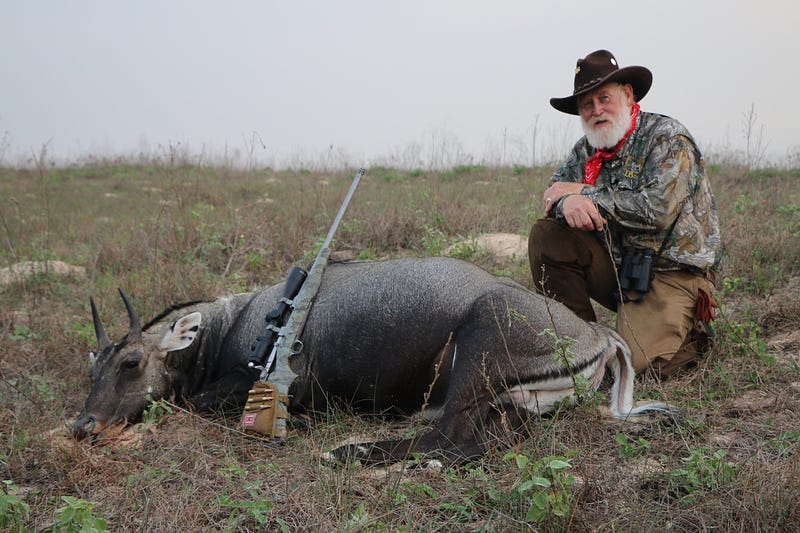
I gently pressed the trigger and following the shot the bull fell backwards. As I was chambering a second round, I saw his tail lift and his hind legs fell. After hitting the ground, he never moved but just in case, I was ready to take a quick follow-up shot.
As we approached the downed bull, I started reminiscing on the time Charlie and I spent together, the stalks we went on, the animals we have seen and stories we shared. Before accepting Charlie’s congratulatory hand, I said a prayer of thanks to those who had had the insight to introduce India’s sacred blue bull to Southern Texas.