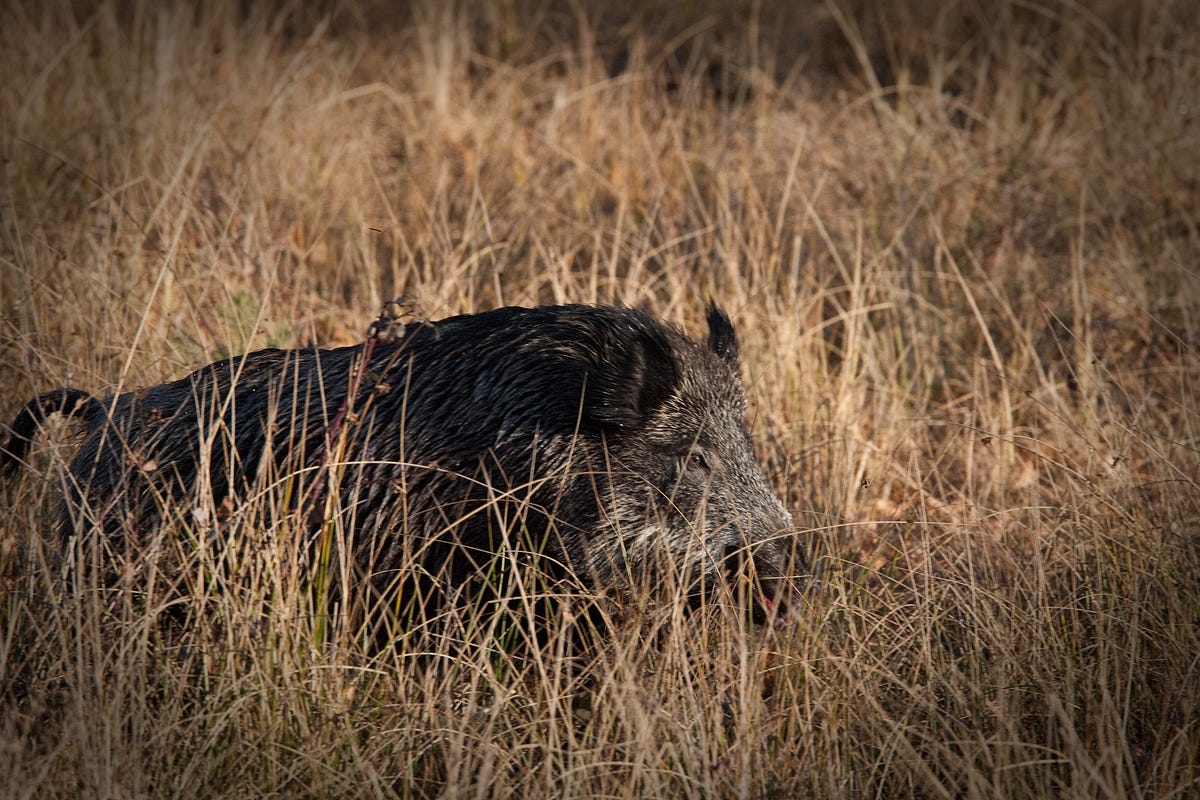
To us Americans, the idea of shooting a moving mammal is pretty foreign — a few hunters might shoot a coyote on the move, or a jack rabbit, but a big mammal, such as deer or wild hogs? It’s just not something we are familiar with. On the European continent, however, one of the great sports is the driven hunt, one of the most traditional and exciting ways of hunting the wealth of game that you can find in Europe, and something I had the privilege to enjoy in France.
We were in the Sologne region, in the Loire Valley, a rural landscape, covered in large swathes of vineyards but also vast, ancient forests, which was where Jean-Phillipe Bourgneuf, our outfitter, had organized our hunt. A practice session, on a running boar target, gave me the chance to familiarize myself with the Sauer 100 in 308 Win that I’d be using and a bit of confidence — essentially, it’s not that different to shooting with a shotgun at a clay, though being able to reload fast and smooth is a pretty vital part of the skill in case a follow-up shot is needed.
With bright, clear weather, we gathered to hear Jean-Phillipe’s briefing. He’d explained, while we were practicing, the ideal spot for a shot — higher and further forward than I expected, but as he explained, trying for a heart shot would risk a gut shot on a moving animal, where his preferred shot would bring a boar down instantly. The number one rule on pretty much all driven boar hunts, is not to shoot the lead females. Here, we were able to shoot smaller boar of any sex that were less than 60cm — I was saved the mental arithmetic of converting that to inches: “No higher than your knees.” Large boars were also fine, as were roe deer. It’s one thing knowing, but what about identification? When a sounder is running past you at 25 miles an hour, how the hell can you tell a boar from a sow? “Three things,” Jean-Phillipe said, “A boar has two humps — one on the shoulder and one on the hind quarters, it has tusks and a pizzle, and, probably the most noticeable, it will be covered in mud.” And in case you are wondering what the pizzle is: it is the barely visible penis… Mud is what proved to be the easiest and most certain identifier — not a single big boar shot wasn’t slathered in the stuff.
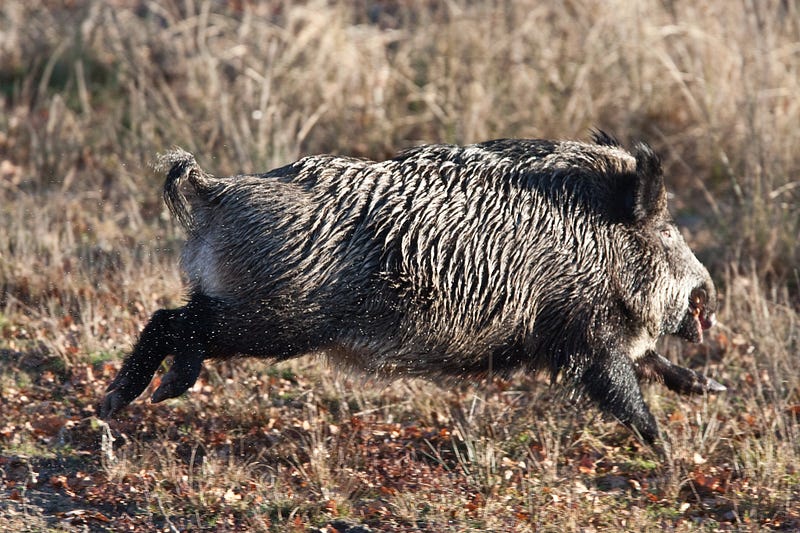
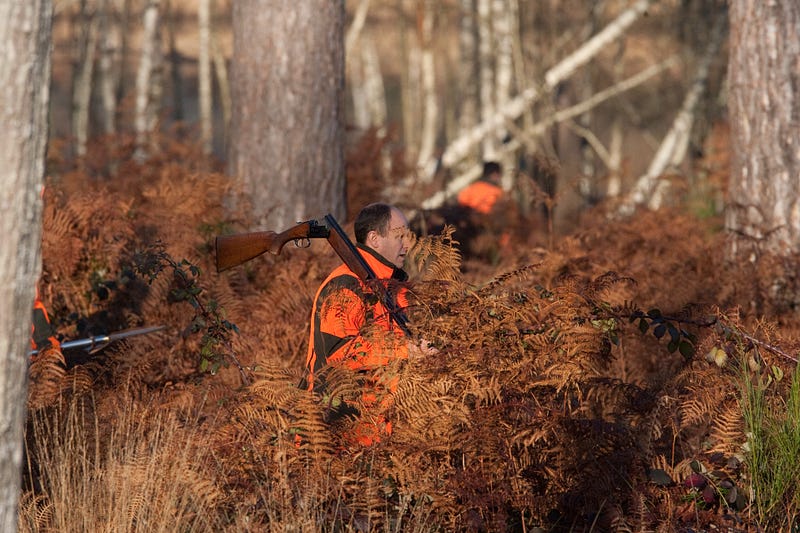
Fully briefed, we were deposited near our stands — wooden, elevated platforms, set on the drive in a line. I was aware of the neighboring hunters, some 150 yards to the left and right of me. It sounds pretty close, but the rules are strict. You shoot only in front of you, as not only do you have neighbors, but the beaters are pushing the boar from behind the line. As we walked to my stand, a sounder hurtled past, a sign of things to come. And once I was on the stand, there was no time to lose, as the first horn sounded, a single blow, signaling the start of the hunt. I’d barely loaded before the cacophony began.
Directly in front of my stand was a cleared track in the forest, its edges formed by bracken, a high fern-like plant that grows in abundance here, and which would obscure boar until the second they hit the track. The track itself was no more than 50 yards wide, and that would be my window, not only to take a shot, but also to spot, assess and decide on whether it was an animal I could shoot. The confidence I’d built up at the practice range ebbed away.
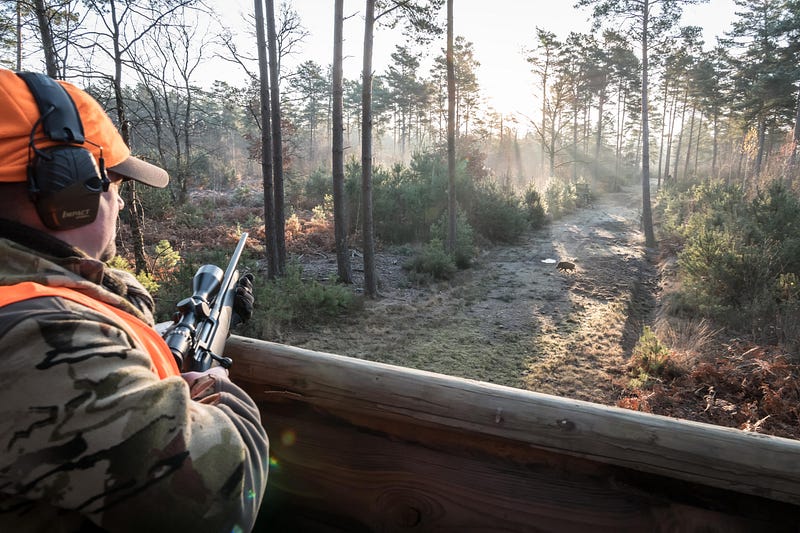
We’d been warned that four blasts on the horn signified an approaching sounder, but I hadn’t been warned just how noisy one of these days was going to be: the shouts of the beaters, packs of barking dogs, the horn blowing and, periodically, rifle shots echoing around the forest. The excitable yells, in French, I didn’t understand, but I soon got to recognize the sound of dogs with boar that wouldn’t move, when their barking became frantic, reaching fever pitch, until the animal was pushed through the line of Guns. Invariably, this would be a big boar, adding to the anticipation.
There were pigs running all over the place, and I caught a glimpse of movement from the left, between the trees. As though they knew what lay ahead, the pigs slowed as they approached the cleared track, before making a break for it, some 50 yards away from my stand. Mud — that was definitely mud. Without realizing I had moved, the rifle was on my shoulder and I was swinging through the boar’s line, and I’d fired and reloaded, but no second shot was needed. The boar nose-dived into the bracken on the right hand side of the track, skidding to a halt as it expired.
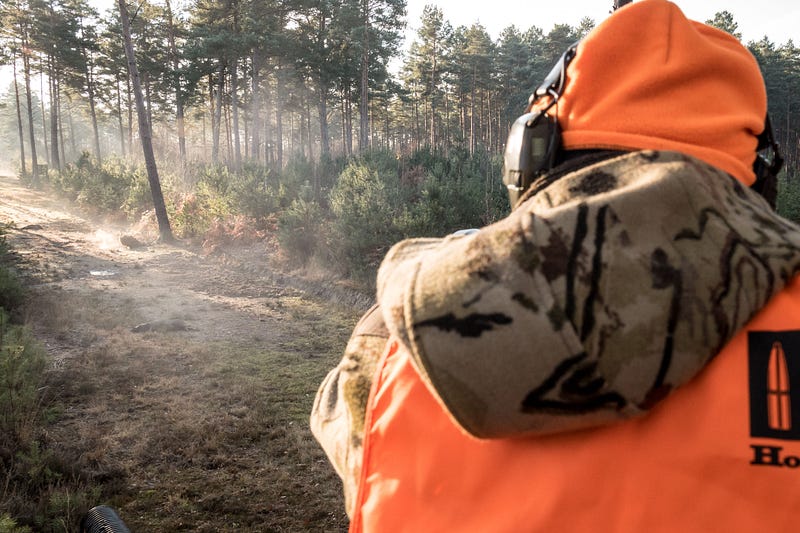
It brought home the necessity of the right ammunition for this style of hunting. During a driven hunt like this, there is no way you leave your stand until you hear three blasts on the horn, signifying the end of the drive. So, while you try to mark where you’ve shot a boar, and where it has headed, it might be some time before it is tracked. Even if the shot has been a perfect one, an animal travelling at 25 miles an hour doesn’t always come to a dead stop, and the thick cover means it can be hard to find. Ammunition, therefore, needs to have not only excellent terminal performance but must be of the type to pass all the way through the animal to give the dogs a blood trail to follow.
As the drive continued, time became irrelevant and I had no notion as to whether I’d been on my stand for minutes or hours. The thrill of the sound of excited voices, yelping dogs and the intermittent horn blasts raised the heart rate: would the next boar pass my stand? Constantly alert and ready to raise the rifle, I tried to discern where my next chance might appear and even then, was almost caught off guard when it did. The blast of three horns to stop the drive brought relief and disappointment in equal measure. Finally my breathing slowed and I could relax. Three boar, all dead with one shot apiece, was my contribution.

Hornady’s Precision Hunter in 308 proved effective for wild boar hunting
As soon as the final horns sound, the rules are clear: unload and under no circumstances must anyone take another shot. It wasn’t long before the trackers appeared, each with a motley crew of dogs: dachshunds, spaniels, bull terriers and German pointers were all in there, as well as mixed breed dogs, all hunting nose to the ground to locate fallen quarry. With no French, I had to rely on gestures to indicate where the three I’d shot had dropped, and as we headed back to our transport, I was assured they’d all been found.
Back at the lodge, hunters were chattering excitedly, reliving each moment of glory or each chance lost, still high on adrenalin and the thrill of the day, as a huge tarp was laid out in anticipation of the animals retrieved. An essential part of a driven hunt is what is called the “Tableau” — meaning a painting, picture or scene, to show due respect to the game that has been killed. Each country has a slightly different tradition surrounding this, but it is done, universally, with a reverence to the animals, to give thanks for a good hunt. Here, the single roe deer shot was laid out first, followed by the wild boar, in order of size.
Of the 43 animals shot in total, 40 had been retrieved immediately, and we heard later, the other three were also found. It was a testament to the skills of these European hunters, but also to the ammunition — every animal that had been hit in the vitals had dropped dead within seconds and stopped pretty much on the spot.
As the day drew to a close, and dusk gathered, so did we, the hunters, and the beaters, surrounding the Tableau. Three horn blowers, decked out in red-coloured knee-length coats, stood with their backs to the beasts, the bowl of their horns facing the Tableau. The crowd quietened. Each large game animal has its own tune to honor it, and the roe deer was saluted first, followed by the wild boar. Then a final tune to the hunt, at which every person removes their hat as a sign of respect. As the final blasts of the horns faded away, silence fell, giving me a chance to reflect on the extraordinary excitement and thrill of hunting driven game.
For most of us in the US, hunting wild hogs is not considered in the same league as hunting, say, whitetail. It’s just something you do if there are wild hogs where you live. But for many Europeans, hunting wild boar is not just a vital part of protecting crops. It’s accompanied by a pageantry of hounds, horns and traditions that might at first seem aristocratic and untouchable. But it isn’t — it is an everyman’s sport. Hunting in Europe is generally a bit misconstrued here in the US, where we think of it as limited. With hundreds of quarry species, and the enormous variety of terrains you find there, that couldn’t be farther from the truth. The hunt is a major event in the winter timetable, and a huge amount of respect is shown to the animals. It’s something families do together, friends do together, as a team. And it’s certainly something I’d recommend to anyone as a trip abroad for hunting.
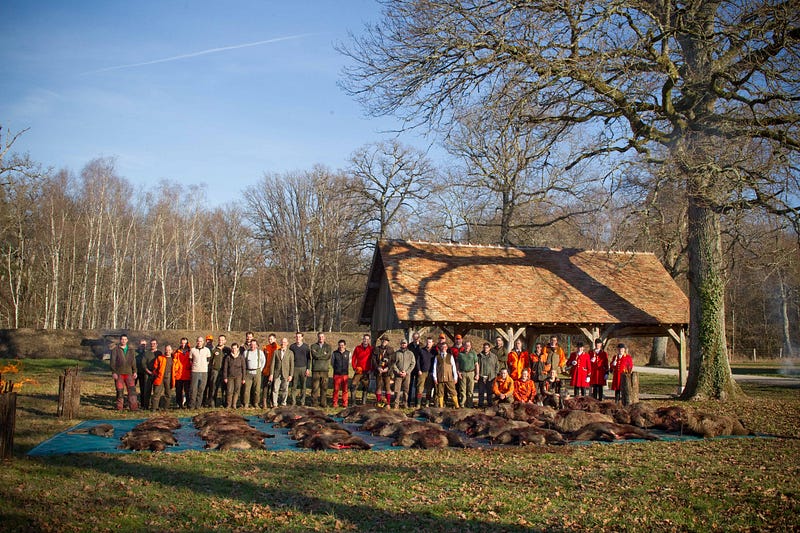
The tableau — a final mark of respect to the boar
Author
By Hornady’s marketing director, Neil Davies