It was raining. Not a slow soaking rain, but a violent downpour complete with lightning strikes so close we could taste and feel them, followed immediately by the deafening sound of thunder. I glanced at Chris Treiber, who smiled and shrugged his shoulders.
I do my best not to be a slave to my cell phone, but I pulled mine out of my coat pocket and turned it on. When it powered up, I touched the icon for weather radar and up popped a map of Texas. Nearly the entire state was covered in various shades of red indicating heavy rain. I zoomed into Central Texas, a weather system was moving from northwest to southeast. Zooming into Llano there appeared a narrow gap between two major bands of rain moving south, suggesting a slowing of rain just before dark, but then rain again most of the night.
I pointed at the phone’s screen, Chris nodded, “If we do get a break the deer should really move. Having rained all day, they’ve been laid up, hidden in the thickets.” He continued, “If we were back at camp we might be enjoying a fire and staying dry, maybe even a glass of red, but we would not be seeing any deer, other than the mounts on the wall.”
I agreed, I’m one of those Texans who enjoys and appreciates rain, and even though I might be knee deep in run-off, I never complain when it rains in our thirsty State. For the past couple of days, we had hunted in rain; we being Blake Barnett, my co-host with “DSC’s Trailing the Hunter’s Moon”, Brian Dungan, Blake’s guide and my guide, Chris Treiber, as well as our respective cameramen. Brian’s wife, DeAnn, whose family owns Sandstone Mountain Ranch had been doing her best to make certain we stayed well fed and successful.
For the first two days of our hunt had pouring with rain. We saw bucks, impressive bucks each time the rain slowed. The second night in camp while steaks sizzled on the grill, Blake and I compared notes. We had both seen bucks we would have shot had we been hunting elsewhere, or if they had been a year or two older.
“The buck we saw this morning when it quit raining for a few minutes, was a good one. He had 10 typical points complimented by an additional eight non-typical points. His beams spread about 18-inches and his primary tines were all as long or longer than his ears — an impressive buck. Then we looked beyond his rack, his neck was fairly slender, the skin about his face and neck was tight. His back and belly lines, too were pretty straight and although his hocks were stained, they weren’t stained like an older mature buck should be right now.” Blake listened attentively. “I would have loved for him to be five or six, but there is no way he could have been older than four.”
Blake responded, “Brian and I saw a couple of almost bucks as well, big eight and 10-pointers, plus several impressive but obviously young bucks. We also saw a big wide-racked deer that looked like he’s got 12 typical points. He walked in behind us and before we could turn around to get a better look he was gone. This morning, we again saw several bucks, when it wasn’t pouring really hard, they came to the Tecomate food plot. One of those bucks was a really massive 10-pointer. He fed for 10 seconds then spotted a doe and took off after her at a run. A few minutes later, a really wide, tall eight-pointer walked to the edge of the field, but he never gave us a chance to get a really good look at him.”
Blake continued, “This afternoon in the rain, the buck we thought was a typical 12-point did almost the exact same thing as the big eight-pointer this morning. Even though he never really gave me a chance to shoot, we did get a good enough look at him to know he’s an old buck. Brian told me, if we see him again to shoot.”
Outside in the darkness it continued to rain as we enjoyed our steaks. Hunger satiated, it did not take long before we yielded to the beckoning of our beds. I woke up several times during the night to the sound of thunder and rain.
Dressed and ready for morning coffee, I headed to the kitchen and was there met by Chris. “Want to hunt another stand this morning, near a fairly remote Tecomate food plot? It’s supposed to continue raining early, but then it may let up as the day progresses. I know you like hunting from the ground, but I think we need to again hunt one of our blinds because of the rain. I know you don’t want to take the chance of getting the cameras wet.” Behind me my cameraman whole-heartedly agreed.

We were in our enclosed blind long before first light. Black grudgingly turned to gray and we spotted movement in the field. It looked like two bucks based on how they moved and the size of their necks. When it finally got light enough to truly see, there were no less than eight bucks feeding around the edges of the Tecomate field. One was very similar to the 18-point buck we had seen before, another was a buck with 10 long points and a decent mass, but he was still young. The other bucks were young six to 10 pointers. There were also 10 does and fawns scattered throughout the field.
As the morning progressed, the rain continued but not nearly as hard as previously and it appeared as if the rain might stop. By good camera light, most of the bucks of any size had disappeared.
Across the field, beyond the brush that surrounded it, Chris and I spotted a deer. Raising our binoculars, we confirmed the deer was a buck with impressive antlers, a rut-swelled neck and darkly stained hocks. He was well over 400 yards distant. He kept coming our way disappearing occasionally behind trees and brush, then there he was, standing right on the edge. He looked left and right, then slowly walked into the field.
I quickly glanced at Chris, who nodding positively. “Larry, he’s a really good, mature buck, the decision is yours.” That’s all I needed to hear.
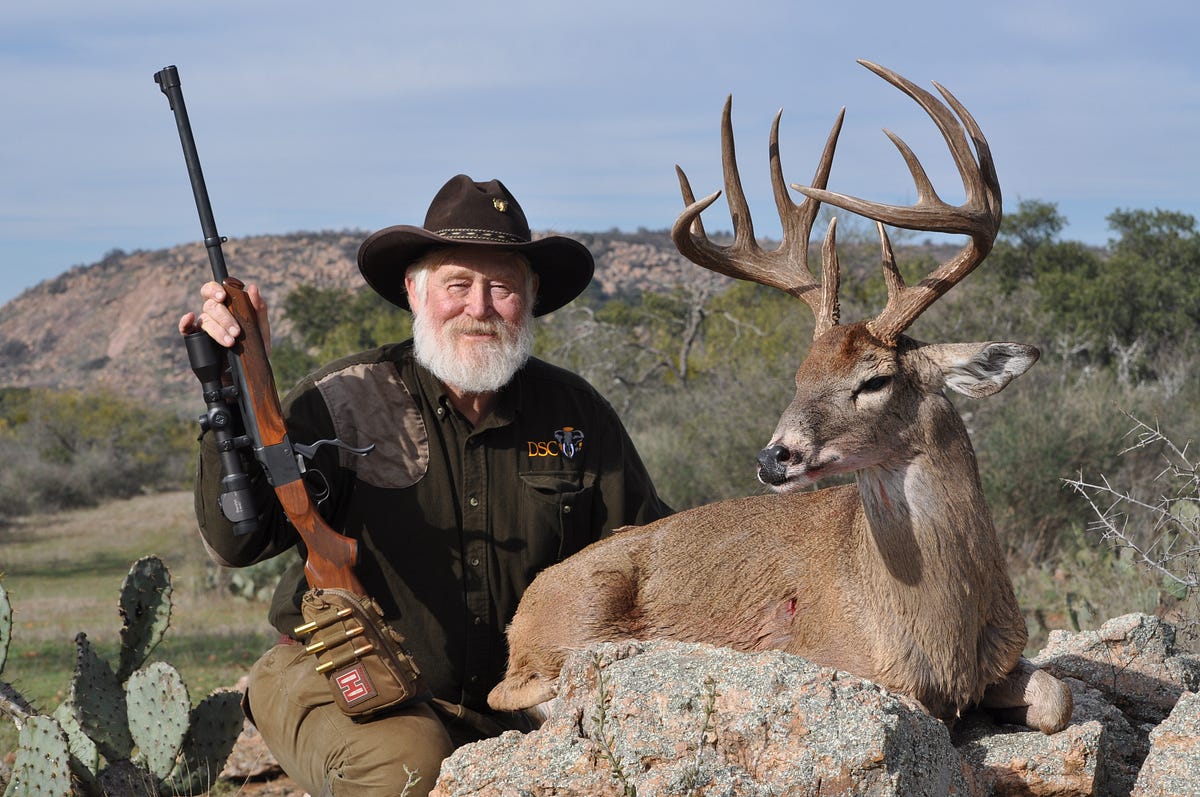
My Ruger Number 1 chambered in 450–400 NE 3” and loaded with Hornady’s 400 gr DGX was pointed in the buck’s direction. I waited until he gave me a perfect shot, took several deep breaths, let out the last one, then gently pulled the trigger.

Hornady’s 450–400 Nitro Express 3" 400 gr DGX cartridge
At the shot the buck took off at a running pace. He nearly made it to the field’s edge before going down. Immediately I reloaded the single-shot and again got on the deer. I stayed on him until I was certain the buck was down for good.
A few moments later Chris and I were at my buck’s side. His rack was absolutely beautiful, 10 long points with split back tines. The buck’s antler’s colors and texture were simply gorgeous. In many ways he had the prettiest antlers I have ever seen on a whitetail, at least in my opinion. After pictures and finishing all we needed to do to for the episode, we loaded the buck and headed back to camp. There we would field dress, then hang him in the ranch’s cooler. I planned on taking the backstraps and one hindquarter. The rest of the meat would be donated to Trinity Oaks. Each year Trinity Oaks provides well over 100,000 pounds of processed venison for food for those in need.
We had just gotten back to camp when Blake and Brian pulled up. I could see deer legs and part of a rack in the back. As I walked to where they were parked, “Got him, I shot the big typical 12-pointer and he’s huge — come look!” Obviously Blake was excited, he continued in stating this was his biggest whitetail ever from our home state of Texas. Indeed, Blake’s buck was impressive and I was thrilled for him. Over a most delicious lunch we told our stories of the morning hunt several times.
One of the great things about hunting whitetails in Texas is some ranches, such as Sandstone Mountain, are under the State’s Managed Lands Deer Permits (MLDP). Once the property is into the program it allows the harvest of bucks and does based on an annual census taken each fall. If you hunt on Texas’ MLDP land you are not allowed to use a tag from your hunting license to tag your deer. You can only use a special tag issued to the ranch owner, so those animals harvested on MLDP property do not count against normal state-imposed bag limits.
After lunch Chris and Brian said, “Larry we have an extremely old 10 point we’ve been watching for the past three years. His antlers still look exactly the same as they did first time we saw him. We’d like for you to take him if we can find him.” I assured them I did. Chris continued, “It looks like the rain is moving out of the area, so let’s plan on setting up a ground blind. We’ll go do that as soon as we finish lunch.”
It took very little to set up the ground blind, and as soon as we did we crawled in. That afternoon we saw several really nice bucks, including a buck that looked like he had well over 20 points, but we did not see the old 10 point that according to Brian had a “flyer” coming off one of his back tines.
That night over a truly delicious supper prepared by DeAnn, we talked about Sandstone Mountain Ranch. I knew some of the ranch’s history, since back when it was established in the early 1980’s I had done some of the biology work on the property regarding whitetail deer. Back then deer from several areas were introduced into the 3,000 acres high fence. No deer have been brought into ranch since those initial introductions. One of the things that had originally intrigued me about the ranch was the terrain and habitat. The ranch encompasses a wide variety of excellent wildlife habitat from a high sandstone and granite mountain to oak thickets to deep soil creek bottoms.
Sandstone Mountain Ranch also has a great deal of water in the form of numerous clear water lakes providing unbelievably good fishing. These add up to one of the more impressive and beautiful ranches in all of Texas.
As we had drove toward the ground blind the next morning, well before first light, it got foggy — dense fog. By the time night turned to dawn it was so foggy we could scarcely see for more than 10 yards. Somewhere in the fog we could hear deer feeding and moving on the food plot. Finally the fog lifted just a little and there were at least seven bucks feeding in the field along with 12 does and fawns and two of the bucks were really impressive.
I was looking at one of those, a really nice typical 12-point, when Chris gently nudged my arm, then pointed at a buck coming to the edge of the field to our left. He had earlier described the buck we were after, as old with 10 fairly short, massive points and a non-typical “kicker” going straight back from one of his back tines. No doubt this was the buck we were looking for.
Earlier I had placed my Ruger Number 1 in the crux of my shooting sticks. My rifle was pointed almost directly at the targeted buck. I waited for him to clear some underbrush, made certain there were no other deer behind him or in the line of fire. Then I pushed the tang safety to fire, planted the crosshairs on the buck’s shoulder and gently pulled the trigger. At the shot the buck ran, but not far, he was down before I could reload.

What a way to end a fabulous hunt on the Sandstone Mountain Ranch. After photos and properly taking care of my deer, we headed back to camp.
This hunt occurred in 2015. Since that hunt Blake and I have returned to the ranch numerous times. We can hardly wait for the next Texas whitetail season to do so once more.
Photo credit: Larry Weishuhn Outdoors