I was still in short britches when I first saw Howard Terpning’s painting of two buffalo hunters, shooting a Sharps rifles rested on crossed arrows. I was enthralled. The fabulous painting made an impression on me. Someday I thought…
Fast forward several years later, I was at my office in Uvalde, Texas working on an article when the phone rang. My daughter Beth, who worked for me in our outdoor media business answered. “Yes Sir Mr. Bachelor, he actually is here!” covering the receiver. “Dad, John Bachelor is on the phone, says he first met you years ago when you, Gramps and Crockett Leyendecker hunted black bear on their property next to the Mescalero Apache Reservation in New Mexico. He wants to invite you on a buffalo hunt in Oklahoma, if you’re interested?”
Moments later John and I renewed our friendship. At the time I was hosting the T/C Game Trails television show which aired on the Outdoor Channel. John had seen our show and tracked me down to invite me on an American bison or buffalo hunt.
Since we had last talked, John had moved from New Mexico to central Oklahoma where he was in the cattle business. Loving buffalo and the days of the buffalo runners, he had bought several American bison and released them on his property. John soon learned buffalo do not respect five-strand barbed wire fences. Some of the released herd stayed on his ranch, but two older bulls and four cows roamed onto adjoining properties.
“If you can get up this way in the next few days we’ll see if we can find you a buffalo. We’ll use a wagon just like the buffalo runners used to follow the hunters to bring back the hide, skull and meat. Too, I’ll have my brother and several friends on horseback scouting adjoining ranches to find a bull. Once they locate them, we’ll head that way, then you can stalk and shoot one. It should make a most interesting episode for your show and be great fun,” explained John.
I agreed, then called the cameraman I was using at the time. Two days later my partner in our then whitetail outfitting business, Bill Whitfield, the show’s cameraman and I were on our way north.
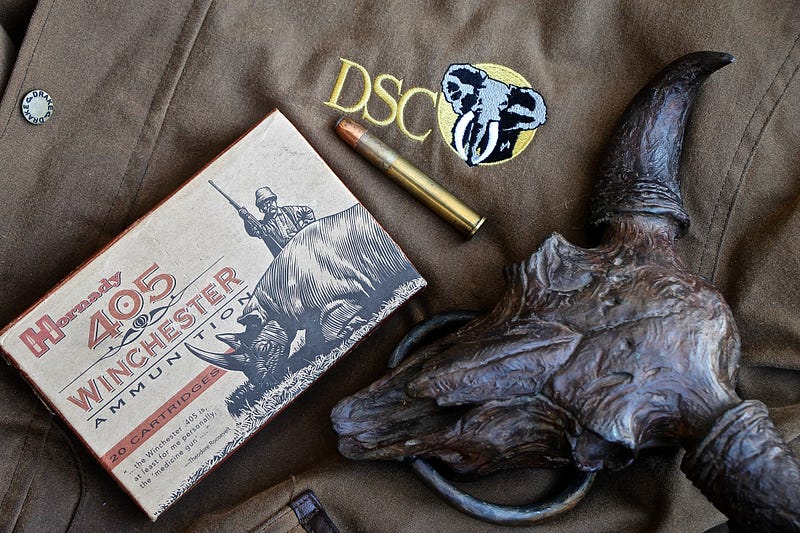
For my buffalo hunt, I decided to use a 405 Winchester rifle loaded with Hornady 300 gr. SP InterLock. This was before Trijicon was building scopes, otherwise I assure you my rifle would have been topped with one of their AccuPoint scopes. I had used the same 405 Win rifle in Africa on greater kudu and other plains game, as well as on mule deer in western Texas. The 405 Winchester was Teddy Roosevelt’s go-to rifle for hunting dangerous game and was one of the reasons I chose that particular round.

The 405 Winchester, loaded with Hornady 300 gr. soft point InterLock
The first day, we spent all day looking for roaming buffalo and it was the same the second and third day - fun horseback and wagon rides, but no buffalo.
On the fourth morning our scouts located a bull and three cows 10 miles from the home ranch. They were feeding in a northerly direction along the side of a deep, brushy creek. It was mid-afternoon before my cameraman and I finally spotted the buffalo. They were still feeding along the edge of the brushy creek. We hiked to get around to their back side, then stayed in the creek bottom until we thought we might be just ahead of them, there to wait in ambush.
I crawled up the steep bank, peered into the bluestem grass plain bordering the creek. Nothing! They were nowhere in sight. It was hard to believe animals as large as a near one-ton buffalo could simply vanish. Maybe they had sensed danger and had run away, or perhaps they had dropped into the brushy creek bottom and we had walked past them.
Then immediately to my right, I saw something huge and brown walk out of the head-high brush into the tall grassy plain. It was a monstrous, shaggy buffalo. Obviously based on his size and horns he was a bull. I moved cautiously to my right. There I could see the bull’s shoulder and vitals. I raised my 405 Winchester. I knew Roosevelt considered that round his “big medicine” and had used it to take African buffalo, rhino and even elephant. Still at the moment, looking at the enormity of the buffalo, even Roosevelt’s choice for dangerous game seemed small and light.
I raised the single-shot rifle and tracked the bull’s movement. When he cleared a bush, I pulled the trigger.
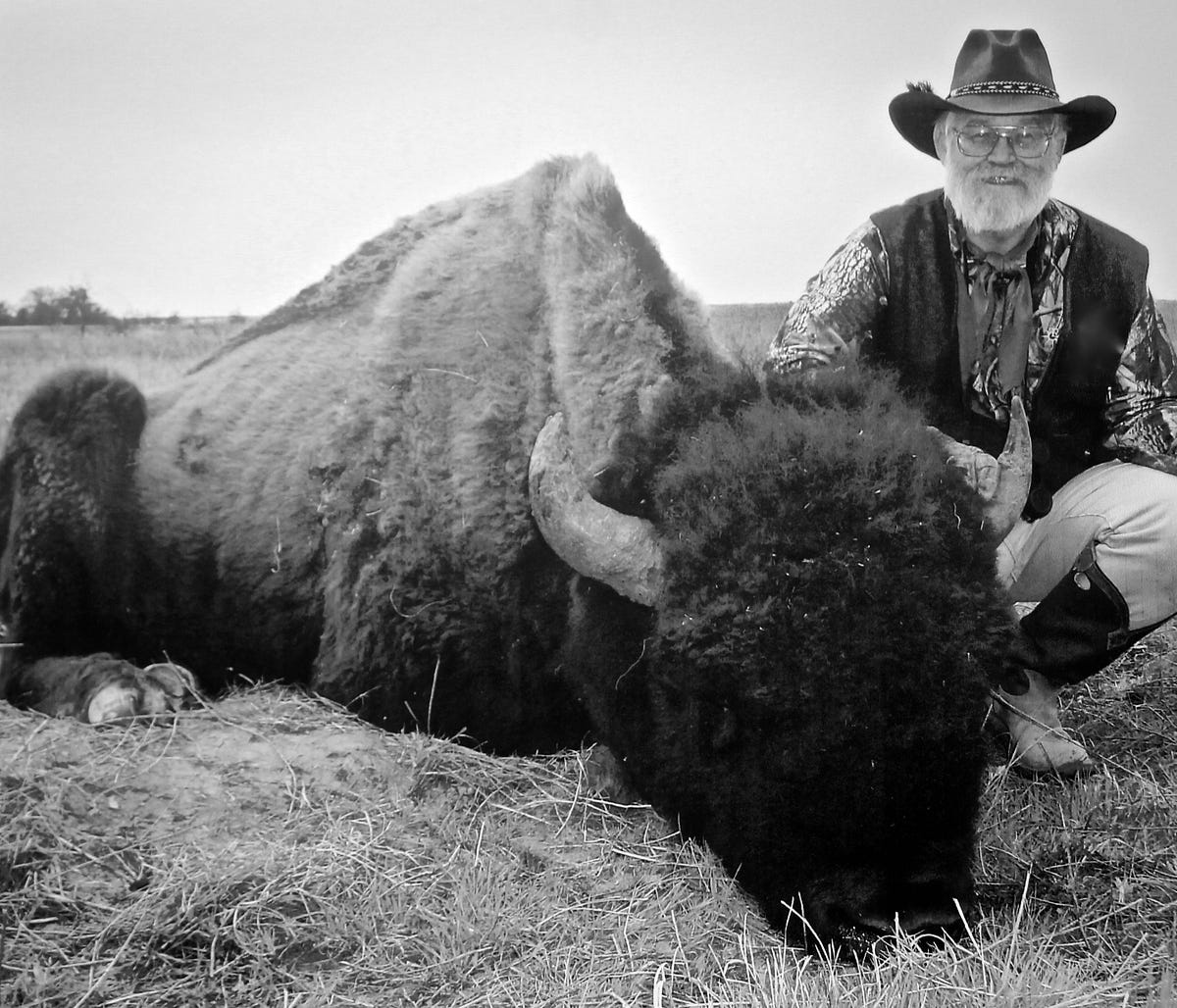
I am pretty quick at reloading single-shot rifles, particularly Ruger №1s, but before I could replace the spent case with a fresh Hornady round, my buffalo dropped. I reloaded and moved forward, keeping my rifle trained on the bull now laying on his side and breathing his last. He was down for good.
For years I had wanted to take a buffalo, an American bison, going back to my growing up days. In my early teens I had found a buffalo skull which washed out of the creek bank on my grandfather’s property. This, coupled with seeing Terpning’s buffalo hunting painting, created a long-held yearning to hunt a “tatanka”, the Lakota term for American buffalo, translated to “big beast”. Finally, many years later I taken my own buffalo.
We spent the rest of the day taking care of the hide and meat, which was not an easy chore. I will admit, I gained a whole new appreciation for those hunters of yore who hunted bison.